Restaurant Daily Closing Checklist — UAE 2026 Guide
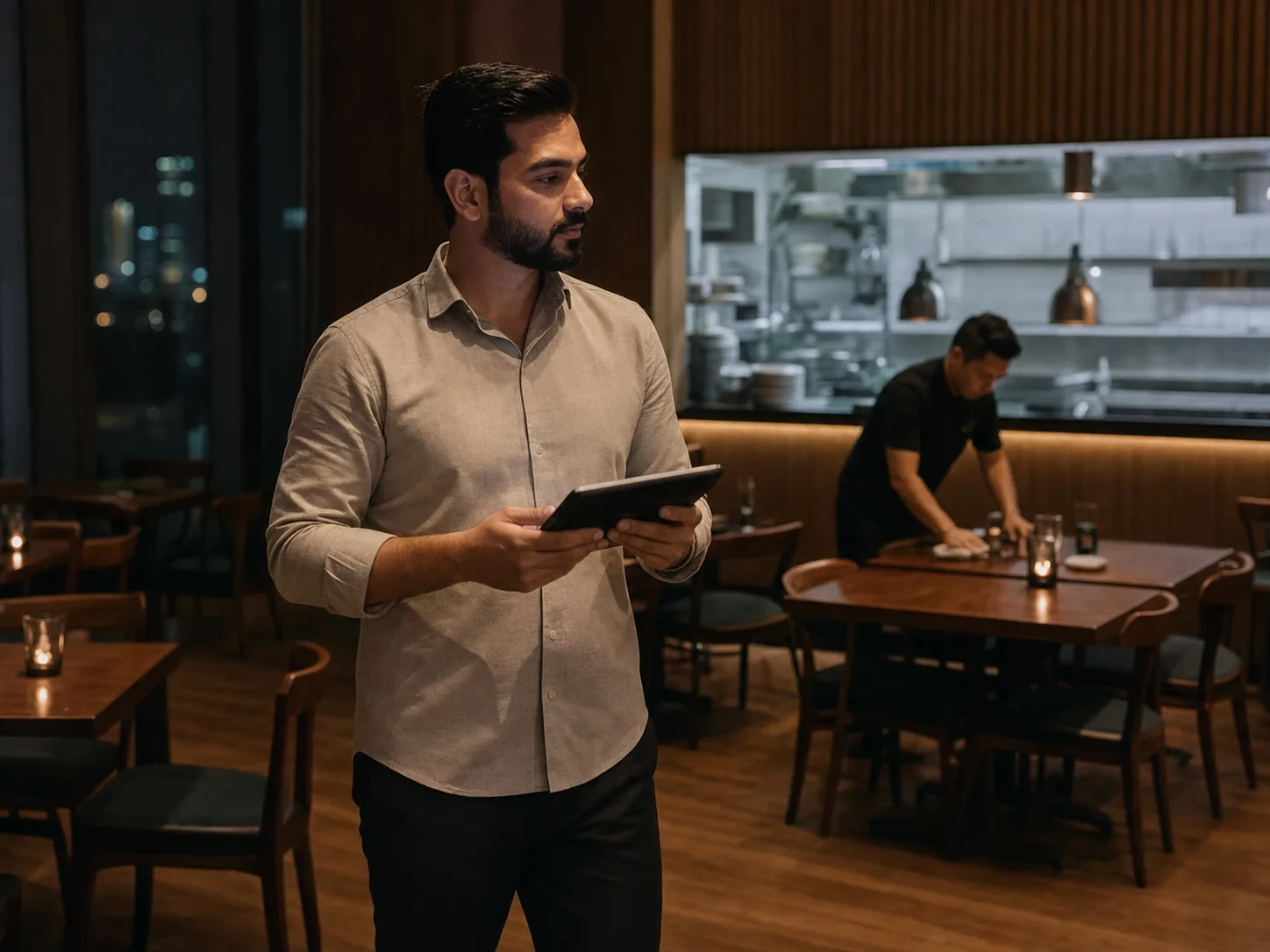
A daily closing checklist for a UAE restaurant is not a productivity exercise — it is the audit trail Dubai Municipality and the Federal Tax Authority expect to see. Six closing zones, anchored to real Food Code 2.0 rules: temperature logs (cold ≤ 5 °C, hot ≥ 60 °C, frozen ≤ -18 °C), cleaning records, Foodwatch entries, pest-management logs, Z-report cash reconciliation and stock count. Get them right and the inspector finds nothing. Get them wrong and the same shift becomes a fine, a downgrade or a closure.
This guide skips generic "10 closing tips" content. Every rule below traces back to either the Dubai Food Code 2.0 (Final Draft, 12 July 2023), the FTA's VAT record-keeping regime under Federal Decree-Law No. 8 of 2017, or named industry practice from Danny Meyer's Setting the Table. The closing zones are organised so a GM at a 60-seat restaurant in JLT can hand the page to a shift lead tonight and run a clean close in under 75 minutes.
In this guide
- Why most closing checklists quietly fail
- What Dubai Municipality actually requires at close
- Zone 1 — Kitchen: temperatures, cooling, cross-contamination
- Zone 2 — Cleaning, disinfection and chemical control
- Zone 3 — Cash, Z-report and FTA reconciliation
- Zone 4 — Inventory, waste and next-day prep
- Zone 5 — Foodwatch / DMChecked digital records
- Zone 6 — Walk-through and lock-up
- Template, ownership and digitising the close
- Frequently asked questions
Why most closing checklists quietly fail
Walk into ten Dubai restaurants on a Tuesday at 11:55 pm and you will see ten versions of the same problem. The closing checklist exists. It is laminated, taped to the kitchen wall, and signed by the same shift lead every night — sometimes before the close is actually done. The temperature column is filled in with eerily consistent numbers. The waste log is empty. The Z-report has been printed but the cash count was a glance.
None of this is laziness. It is what happens when a checklist is treated as paperwork rather than as the actual operating system of the restaurant. Danny Meyer's framing in Setting the Table applies directly: hospitality starts with how the team treats the building, not the guest. A close that is genuinely run — temperatures actually measured, surfaces actually swabbed, cash actually counted twice — is what allows the team to open the next morning without the slow accumulation of small failures.
The UAE difference. A US or UK closing checklist is built around best practice. A Dubai closing checklist is built around statutory requirements. The 5 °C / 60 °C / -18 °C thresholds are not advice — they are clauses 3.4.2.a.i and 3.4.2.a.ii of the Dubai Food Code 2.0. Foodwatch entries are not optional. The Z-report is the first document in a five-year FTA evidentiary chain.
What Dubai Municipality actually requires at close
Dubai Food Code 2.0 does not publish a single "closing checklist" template. What it does, across sections 3 and 4, is define the records that a closing checklist must produce. The most consequential are clustered around three obligations.
An operating HACCP system with monitoring records. Section 3.1.3.a states that "all food establishments in Dubai should implement and maintain a Food Safety Management System (FSMS) based on Codex principles of Hazard Analysis and Critical Control Point (HACCP)." Section 3.1.3.n adds the documentation rule: "Records associated with the monitoring of each CCP shall include the date, time, and result of measurement and shall be signed by the person responsible." Audit reports must be retained for at least three years (§3.1.3.2.e).
Suppliers and pest control on a Dubai Municipality digital platform. Section 3.2.2.1.c requires that "food establishments shall ensure that all their suppliers are registered on the Foodwatch platform." Section 4.4.6.a goes further on pests: "management of food establishment shall use digital tools and systems provided by Dubai Municipality for managing all documentation and recording of data linked to pest management." Inspectors check these digital records during both scheduled and unannounced visits.
A written cleaning and disinfection schedule. Section 4.2.6.d requires a written cleaning schedule that specifies nine things — what is cleaned, the chemicals and materials used, dilution and contact time, method, frequency, time required, the named person doing it, safety precautions, and who is responsible for monitoring and recording completion. A blank wall-mounted form does not meet this.
Layered on top of all of this is the FTA's record-keeping regime. Under Federal Decree-Law No. 8 of 2017 on VAT and the Executive Regulations issued under Cabinet Decision No. 36 of 2017, every VAT-registered business — which means every restaurant turning over more than AED 375,000 a year — must keep records of all supplies, purchases and tax invoices for five years from the end of the relevant tax period. The Federal Decree-Law No. 47 of 2022 on corporate tax extends this to seven years. The Z-report and shift cash declaration are the documents that anchor that chain on the operations side.
Zone 1 — Kitchen: temperatures, cooling, cross-contamination
The kitchen close is the highest-stakes zone because the records produced here are exactly the records inspectors ask for first. Three sub-systems need to be run separately and recorded separately.
Temperature logs (the non-negotiables)
Section 3.4.2 of Food Code 2.0 sets the storage temperatures every restaurant must hit, every shift. The closing log should include a reading taken in the last hour of service for each of the following:
| Unit type | Required temperature | Food Code 2.0 clause |
|---|---|---|
| Chilled storage (high-risk food) | ≤ 5 °C | §3.4.2.a.i |
| Hot holding | ≥ 60 °C | §3.2.11.a / §3.4.2.a.i |
| Frozen storage | ≤ -18 °C | §3.4.2.a.ii |
| Dry storage | < 25 °C, 60-65% RH | §3.4.2.b |
| Dishwasher final rinse | ≥ 82 °C | §4.2.3.b.i |
Two things make this column real instead of cosmetic. First, the probe thermometer is calibrated — Food Code 2.0 §2.7.4 explicitly requires periodic calibration of measuring devices. Second, the reading is taken before the team starts breaking down the line, not after, because every minute a fridge door is open while sticky pans are cleaned out is a minute the unit drifts above 5 °C.
Cooling cooked food correctly
If the kitchen has cooked stock, sauces or proteins that will be cooled and held overnight, Food Code 2.0 §3.2.12 imposes a hard two-stage cooling rule: from 60 °C to 20 °C within two hours, then from 20 °C to 5 °C within four hours — a six-hour total window. Food that has been cooled and refrigerated should be consumed within 72 hours (§3.2.12.b). Date-label every container with the date of chilling, not the date of preparation.
The "time as safety control" trap. Section 3.3 allows brief departures from temperature control — but with severe limits. High-risk hot food held between 5 °C and 60 °C must be discarded after 2 hours. High-risk cold food, after 4 hours including preparation time. If a covered prep batch sat out on the pass while the team finished service, it is in the danger zone — and the closing checklist needs an "is this food going home or going in the bin?" decision, not a default save.
Cross-contamination at lock-up
Section 3.5.1.n mandates color-coded cutting boards for four separate categories: ready-to-eat foods, raw ready-to-eat animal and sea food (such as fish for sushi), raw vegetable foods intended to be cooked, and raw animal foods intended for cooking. The closing routine should physically verify that boards have been segregated to their colour zones — not just put away. Ready-to-eat food must be stored in sealed containers, placed above raw food in any shared chiller (§3.5.1.h–i).
Zone 2 — Cleaning, disinfection and chemical control
Cleaning is not a single task. Food Code 2.0 §4.2.1 distinguishes between food-contact surfaces (must be cleaned and disinfected to prevent residue buildup and pathogen growth, with cutting boards used for raw food or RTE food cleaned and disinfected between each use) and non-food contact surfaces (cleaned at a frequency that prevents accumulation of dirt and grease). §4.2.1.e adds a sequencing rule that gets violated often: cleaning runs high-risk area to low-risk area, with the sequence walls → non-food contact equipment surfaces (cupboards, refrigerators, cooking ranges) → floors.
The written cleaning programme required under §4.2.6.d must specify the nine elements covered above. In practice, the closing checklist references it rather than duplicates it — the GM signs off that the day's items on the rotating cleaning schedule have been completed, with the named person initialling each.
Chemical control is a separate closing task. Section 4.5 requires that all chemicals — sanitisers, biocides, detergents — be stored in clearly labelled non-food containers, in a compartment separate from food and food-contact surfaces, and where appropriate lockable. The end of shift is when temporary spray bottles get parked in the wrong cupboard. Adding a single line item — "all chemicals returned to locked chemical store, labels intact" — closes that loop.
The dishwasher itself is a record-producing unit. Under §4.2.3.b.i, after cleaning, food contact surfaces, equipment and utensils shall be disinfected to a temperature of 82 °C in a dishwashing machine — and §4.2.3.b requires that the machine "shall be equipped with a temperature measuring device that indicates the temperature of the water in each wash and rinse tank." Log the final rinse temperature on the closing form along with the cold-storage readings.
Zone 3 — Cash, Z-report and FTA reconciliation
The financial close has two outputs: an operational record (was the till short or long?) and a regulatory record (does this Z-report tie back to the day's VAT-bearing sales?). Both must be archived for at least five years for VAT purposes and seven for corporate tax under Federal Decree-Law No. 47 of 2022.
The right sequence is:
- Close out the POS shift. Print the Z-report. It must show revenue split by payment method, total order count, average check, discount and void totals, and the declared starting cash.
- Count the drawer twice. Once by the shift lead, once by the manager. Reconcile against the declared cash plus cash sales minus cash refunds.
- Resolve discrepancies in writing, not memory. Any difference greater than AED 20 should be noted on the close form with a one-line cause (counted twice, recount holds; manager comp not entered; suspected till error — investigate tomorrow).
- Drop cash to the safe. Witnessed by a second person. Time-stamp the drop.
- Archive the Z-report. Paper, scan or directly into accounting — but the same archive for five years, kept retrievable by date for an FTA audit.
Refunds and voids deserve their own line on the close. Under FTA Public Clarifications, any tax adjustment requires a credit note or a corrected invoice — meaning the underlying void must be traceable to the original tax invoice. A POS that logs voids by operator with a timestamp turns this into a one-minute review at close; systems that don't turn it into next week's nightmare when the accountant runs the VAT return.
Zone 4 — Inventory, waste and next-day prep
Inventory at close has two jobs. The first is to flag any items that need to be reordered before service tomorrow — a par-level scan on critical SKUs is usually enough. The second is to record waste. Food Code 2.0 §3.4.5 requires that food that has been "subject to recall, or has been returned, temperature abused, contaminated or damaged" be kept separate, marked, and documented with details communicated to the supplier. That documentation is most easily generated at close, when the team knows what got pulled from service.
Stock rotation runs to a "first-in, first-out" rule under §3.4.4.a. The closing walk should physically verify the FIFO order on at least one prep fridge per night — not the whole walk-in. Rotating the audit prevents the chef from cleaning up one fridge for show while the rest drift out of order.
If the restaurant runs a daily count, this is also where it happens. If it runs weekly counts, the close should still capture a "key SKU" list — typically protein and high-value seafood — to catch theft or measurement drift before it compounds.
Zone 5 — Foodwatch / DMChecked digital records
The Foodwatch platform (now branded DMChecked after the 2025 transition) is the layer most operators under-invest in. Under §3.2.2.1.c every supplier the restaurant buys from must be registered on Foodwatch with declared and approved activities. Under §4.4.6.a, pest-management documentation — pest control agency visit reports, corrective actions, and preventive actions — must live on the DM digital platform, not in a binder.
What this means at closing time: the shift lead enters that day's temperature readings into the digital platform (if the establishment is in scope), confirms any new supplier deliveries against the Foodwatch supplier list (a delivery from an unregistered supplier is a fineable event), and uploads or links any pest-trap inspection notes from the day. Dubai Municipality has been explicit, in §3.1.3.d, that "the food establishment shall use new and evolving technologies to digitalize the food safety management system as much as practically possible." Paper that never gets transcribed has stopped counting as compliance.
14 allergens, every menu. Section 3.6.1.b mandates that food establishments declare 14 specific allergens whenever present: crustaceans, peanuts, soybean, tree nuts (almonds, hazelnut, walnut, macadamia, pecan, pistachio), sesame, fish, eggs, milk, gluten-containing cereals (wheat, rye, oats, barley, spelt), celery, mustard, sulphur dioxide and sulphites, mollusks, and lupine. Closing is the right moment to check that the next morning's menu reflects any recipe changes made during the day — particularly for specials.
Zone 6 — Walk-through and lock-up
The final zone is the simplest in content and the most often skipped in execution. A single named person — usually the closing manager — walks the building in a fixed order: kitchen first (gas off, hoods off, ovens cool, dishwasher drained), then bar (bottles secured, tills closed), then floor (chairs up, lights down, music off), then back-of-house (lockers, staff entrance). Refuse goes out the same night under §4.4.3.c: "refuse … should be cleared at least once a day, preferably every night to avoid leaving refuse overnight." Bags tied. Bins covered. Exterior bins not overflowing — that is what attracts the pests that the rest of the closing routine just spent an hour preventing.
Last: the closing manager initials the close form, photographs it (or it is captured in the digital system), and the building is locked. The Z-report, temperature log and Foodwatch entries should be filed before the manager leaves the building — not "tomorrow morning."
Template, ownership and digitising the close
Three things turn a paper checklist into a system that actually runs.
Ownership by zone, not by document. Each of the six zones has a named owner per shift. Kitchen close belongs to the head chef on duty. Cleaning sign-off belongs to the senior dishwasher. Cash belongs to the closing manager. Foodwatch belongs to the Person in Charge (PIC) — the Food Code 2.0-mandated supervisor (§5 / §6.1) responsible for food safety on shift. Putting a single name beside each zone removes the diffused-responsibility failure mode.
One physical artefact per night. Whether it is a printed form, a tablet workflow, or a series of digital entries, there should be one canonical record produced per close — not three half-completed copies. That artefact is what a Dubai Municipality inspector or an FTA auditor will ask for.
Variance loops, not just checks. A checked box that nobody reads the next morning is worth nothing. The strongest closing checklists feed into a morning review: what did last night's close flag? Any temperature out of range? Any cash discrepancy > AED 100? Any waste line over the daily average? This is where Z-reports, par-level alerts and theoretical-vs-actual recipe variance reports stop being paperwork and start being management.
A close run this way takes 45-75 minutes in a typical 60-80 seat venue. Less than 30 minutes is almost always a close that is missing steps. More than 90 minutes is almost always a close with duplicated steps or undefined ownership. The number to optimise is not speed — it is the count of items the morning team has to fix before opening.
Frequently asked questions
What does Dubai Municipality require on a restaurant's daily closing checklist?
Dubai Food Code 2.0 does not publish one mandated "closing checklist" template, but it does mandate the records that the checklist must produce. Under section 3.1.3, every Dubai food establishment must run a HACCP-based Food Safety Management System with date-, time- and signature-stamped records for each Critical Control Point. In practice that means end-of-day temperature logs for cold storage (≤ 5 °C), hot holding (≥ 60 °C) and freezers (≤ -18 °C), plus cleaning and disinfection records, pest-monitoring entries and supplier-verification records on the Foodwatch platform. Audit reports must be retained for at least three years.
What temperatures must I record at closing?
Per Dubai Food Code 2.0 §3.4.2, chilled storage must hold high-risk food at or below 5 °C, hot storage at or above 60 °C, and frozen storage at -18 °C or colder. Dry stores should sit below 25 °C with relative humidity of 60-65%. Any cooked food being cooled overnight must drop from 60 °C to 20 °C within two hours, then from 20 °C to 5 °C within four hours — a six-hour total cooling window (§3.2.12). Log the actual reading from each unit, the time, and the name of the person who took it.
What FTA records does a restaurant need to keep at end of day?
The UAE Federal Tax Authority requires every VAT-registered business to keep records of all supplies, purchases, tax invoices, credit notes and Z-reports for five years from the end of the relevant tax period, under Federal Decree-Law No. 8 of 2017 and Cabinet Decision No. 36 of 2017. For corporate tax purposes, Federal Decree-Law No. 47 of 2022 extends this to seven years. The Z-report and shift cash reconciliation are the daily evidentiary anchor — without them, a later VAT or corporate-tax audit has nothing to reconcile back to.
Is paper-based closing still acceptable in Dubai?
Increasingly no. Section 3.1.3.d of Food Code 2.0 mandates that, where required by the Food Safety Department, establishments shall use evolving technologies to digitalise the food safety management system. Suppliers must already be registered on Foodwatch under §3.2.2.1.c, and pest-management records must be maintained on a Dubai Municipality digital platform under §4.4.6. Inspectors check these digital entries on every scheduled and unannounced visit, so paper logs that never get transcribed are a real risk.
How long should a closing routine take in a mid-size restaurant?
For a 60-80 seat restaurant with a separate kitchen, bar and front of house, a well-rehearsed close runs 45-75 minutes from last guest out. The biggest variables are kitchen deep-clean rotation (some tasks are daily, some weekly), the speed of cash reconciliation, and whether your inventory count is daily or weekly. A loose close that drifts past 90 minutes is almost always a process problem — duplicated steps, undefined ownership, or temperature checks left until the end when fridges have already been opened twenty times.
What is the difference between Foodwatch and DMChecked?
Foodwatch is Dubai Municipality's long-standing digital food-safety registry — mandatory and free to register, used to declare suppliers, log temperatures and store hygiene-compliance records (Food Code 2.0 §3.2.2.1.c). DMChecked is the rebranded successor platform launched in late 2025; existing Foodwatch accounts were migrated automatically. The functional behaviour for a restaurant is the same: end-of-day food-safety entries, supplier verification, self-inspections and pest-management records all live on the DM digital platform, and inspectors check them on every visit.
Sources
- Dubai Municipality — Food Code (English PDF, hosted on dm.gov.ae)
- Dubai Municipality — Food Safety Department
- Foodwatch (Dubai Municipality digital food-safety platform) — mandatory supplier registration and digital food-safety records under Food Code 2.0 §3.2.2.1.c.
- Dubai Food Code 2.0 — Final Draft, 12 July 2023. Source PDF distributed via Dubai Municipality Food Safety Department; sections referenced in this article: §1.1, §3.1.3, §3.2.11, §3.2.12, §3.3, §3.4.2, §3.4.3, §3.4.4, §3.4.5, §3.5.1, §3.6.1, §4.2, §4.4, §4.5.
- UAE Ministry of Finance — VAT — overview of Federal Decree-Law No. 8 of 2017 on Value Added Tax and Cabinet Decision No. 36 of 2017 on Executive Regulations.
- UAE Federal Tax Authority — record-keeping requirements (five years for VAT records under Article 78 of the VAT Decree-Law).
- Federal Decree-Law No. 47 of 2022 on the Taxation of Corporations and Businesses — record retention for corporate tax purposes (seven years).
- Danny Meyer, Setting the Table: The Transforming Power of Hospitality in Business, HarperCollins (2006) — framing for closing-culture as the operating system of the restaurant.