Seafood Suppliers for Dubai Restaurants — 2026 Directory
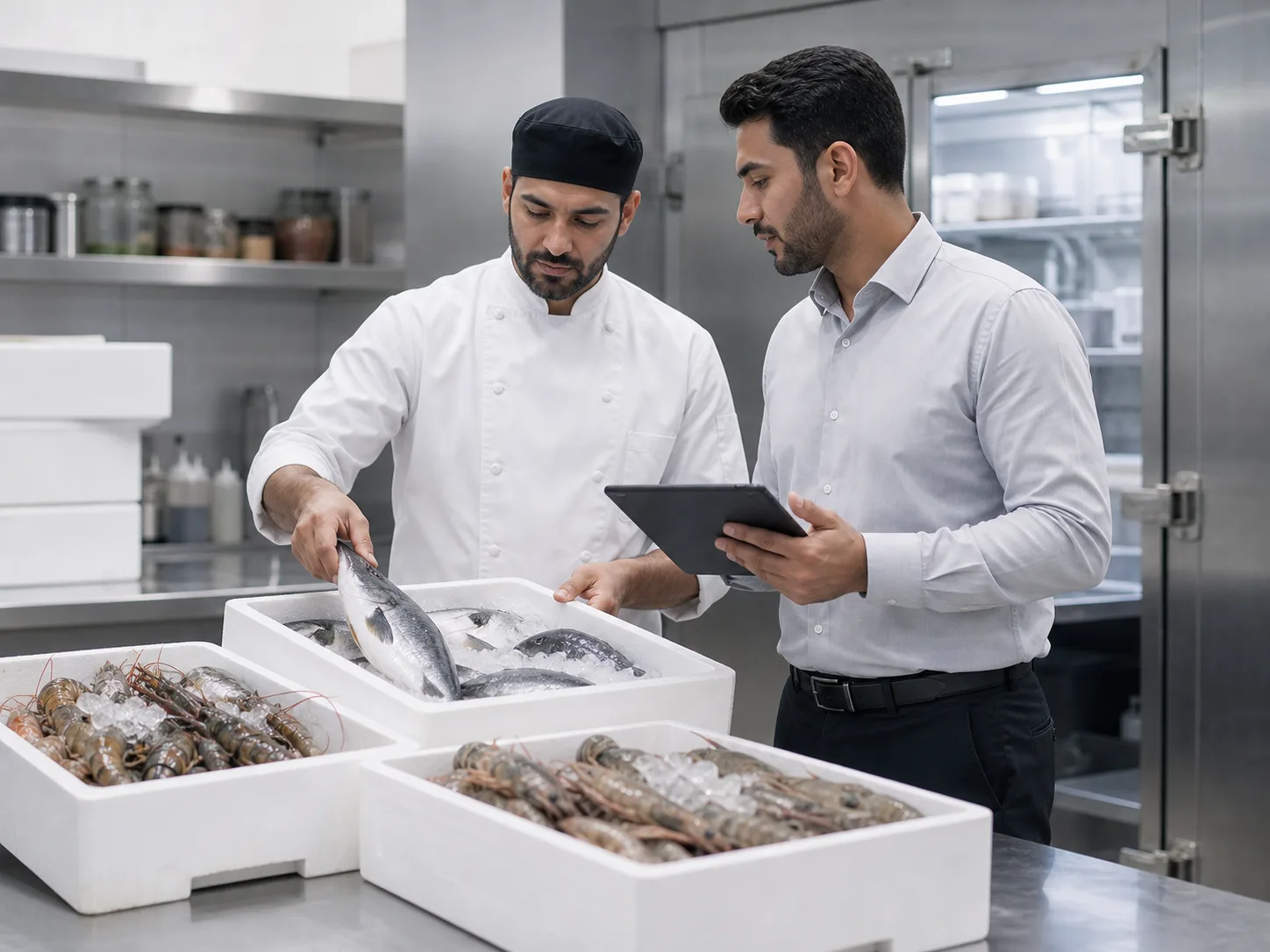
Dubai restaurants source seafood through three channels: the Waterfront Market in Deira (around 600 tonnes traded daily across 260+ species), a handful of HoReCa-focused wholesale distributors (Bidfood Middle East, Gulf Seafood LLC, The Deep Seafood Company, Source International, Asmak), and UAE aquaculture producers such as Fish Farm LLC. This guide lists the verified players by segment, with the seasonal bans and cold-chain requirements every kitchen has to plan around.
The UAE consumes roughly 220,000 tonnes of seafood per year against local production of about 78,000 tonnes — so close to 70% of supply is imported. Per-capita consumption sits near 28 kg, well above the ~20 kg global average. The Dubai market is built around one wholesale floor, a small group of HoReCa distributors that take consolidated orders six days a week, and a fast-growing aquaculture segment that lets restaurants put UAE-farmed salmon and sea bream on the menu. Below is the working directory — who supplies what, where they are, and how the regulatory calendar limits what you can serve in any given month.
In this guide
- The shape of the Dubai seafood market
- Waterfront Market: the daily wholesale floor
- HoReCa wholesale distributors
- UAE aquaculture: farmed salmon and sea bream
- Supplier comparison table
- Seasonal bans you have to plan around
- Cold-chain and receiving rules
- How to evaluate a new supplier
- Streamlining your seafood ordering
- FAQ
The shape of the Dubai seafood market
Three numbers frame how seafood supply works in Dubai. First, around 70% of UAE seafood is imported — local landings cover roughly 78,000 tonnes against ~220,000 tonnes of consumption. Second, per-capita seafood consumption is ~28 kg/year, against a global average near 20 kg. Third, the UAE seafood market is valued at about AED 5.1 billion (USD 1.38 billion) as of 2025. The implication for a chef: most species on your menu travel further than your suppliers' marketing would suggest, and the working sourcing decision is rarely "local versus imported" — it is "imported chilled, imported frozen, locally landed (and seasonally restricted), or UAE-farmed."
Waterfront Market: the daily wholesale floor
The Waterfront Market in Deira, near Hamriya Port at the junction of Al Khaleej Road and Abu Hail Road, is where most fresh whole fish in Dubai actually changes hands. The market traces back to the 1958 Deira Fish Market and was rebuilt as a covered wholesale-and-retail facility opened by Ithra Dubai. It is the busiest single seafood floor in the UAE.
The hard numbers: roughly 600 tonnes of seafood traded daily, 260+ varieties of fish and seafood, 50+ dried-fish varieties imported from global suppliers, and around 150+ seafood and fish stands across the market. Approximately 70% of the seafood is sourced from UAE waters, with the rest imported. The fish market is open 24 hours a day and closes only for deep cleaning every Friday between 12:30 and 14:30.
For restaurant buyers, two things matter. First, the live fish auction runs through the night (roughly 23:00 to 06:00), and the best whole fish — Gulf hammour, sherri, kingfish, jush, safi, faskar — typically clears at auction. Most restaurant purchasing happens through a registered trader at one of the stands rather than direct bidding; the trader runs an account, holds stock for known buyers, and handles paperwork. Second, the market also operates a "Market-to-Table" cooking service for retail visitors — useful for media coverage and chef demos, not for daily kitchen sourcing.
Build a relationship with one trader, not the floor
Restaurants that source successfully from Waterfront Market work through a single named trader they call before the auction closes. The trader sets aside the day's catch by species and size grade, prices it against agreed-upon ranges, and arranges chilled delivery to the kitchen in the morning. Showing up at 06:00 to bid without a relationship is romantic but slow — and the best whole fish is already spoken for.
HoReCa wholesale distributors
For frozen, processed, or imported seafood — and for restaurants that want a single delivery account covering many SKUs — the working channel is a small group of HoReCa-focused distributors with cold-chain facilities and account-management teams.
Bidfood Middle East
bidfoodme.com — Bidfood is the largest foodservice distributor in the region, operating 13 distribution centers, 11 offices, and 7 demo studios across UAE, KSA, Oman, and Bahrain. The UAE arm was originally established as Horeca Trade in 2003 and rebranded under the Bidcorp family. The group runs over a million deliveries per year to 15,000+ customers. In 2017 Bidfood UAE acquired a majority stake in wholesale seafood specialist Wet Fish, folding their seafood range into the broader Bidfood offer. Their myBidfood platform — web and mobile app — was the first dedicated e-distribution system for foodservice in the region, supporting price history, repeat ordering, and delivery tracking. Most Dubai operators use Bidfood as their primary multi-category account.
Gulf Seafood LLC (GSF Frozen Foods)
gsf.ae — Established in 1994 in Jebel Ali Free Zone, Gulf Seafood has been a seafood specialist for the GCC foodservice sector for three decades. The product range covers crab, cod, lobster tails, kingfish, haddock, shrimp, barramundi, salmon, sea bass, squid, mussels, tuna, scallops, octopus, langoustines, sushi-grade product, and pasteurized crab meat. Their facility holds 700 tonnes of frozen storage at -18°C in fully air-conditioned processing halls, and the company is certified under BRCC, FSSC 22000, HACCP, Halal, US FDA, and EU standards. Customer base is heavily weighted to 5-star hotels, fine-dining restaurants, chain restaurants, flight kitchens, and catering companies — a good fit for any operator where consistency on portion size and grade matters.
The Deep Seafood Company
thedeepseafood.com — Founded in 1986, originally to supply Abu Dhabi royal palaces and federal organisations. Today the company operates processing facilities in Ajman, Dubai, and Umm Al Quwain, with its main facility at Mafraq industrial area in Abu Dhabi. Certifications include HACCP, FSSC 22000, ISO 9001, ISO 14001, and USFDA registration. Range covers fresh live seafood and frozen processed product — shrimps, rock lobsters, sand lobsters, crabs, squid, cuttlefish, octopus, fish fillets, and fish steaks. Their warehouse in Meena (W/House 269 near Jumbo) and Abu Dhabi base make them the default option for restaurants in the capital and northern emirates.
Source International
sourceinternational.ae — A wider HoReCa distributor with a strong frozen-seafood line (scallops, prawns, fish fillets) alongside dairy, oils & fats, spices, poultry & meat, and IQF vegetables & fruits. Offices in Spectrum Building, Oud Metha (Dubai) and registered in Dubai Silicon Oasis. Coverage spans the UAE and the wider GCC, with flexible minimum order quantities that suit independent restaurants as well as hotel groups — a useful starting account for venues without the volume to anchor a Bidfood relationship from day one.
Asmak (Alliance Foods Company / International Fish Farming Holding)
asmak.me — Founded in 1999, Asmak is one of the UAE's most established seafood brands and operates an integrated value chain: aquaculture farms (RAS systems) in the UAE, plus processing and distribution facilities at Plot 5310227, Saih Shuaib, Dubai Industrial City. Their product format range is unusually broad for the UAE market: fresh fillets (200–250g) of hamour, sea bass, sea bream, salmon, and white fish; frozen shrimp (medium, large, jumbo; 400 g and 1 kg packs), seafood cocktail, and white fish fillet; breaded products — fish fingers, nuggets, calamari rings, crab sticks, jumbo shrimp bites; and a ready-to-cook line covering shrimp, salmon, sea bass, sea bream, and Nile perch. Asmak is widely distributed through Almunajem Foods and direct accounts to retailers, hotels, caterers, and restaurant chains. Operations also span Saudi Arabia, Bahrain, and Oman.
UAE aquaculture: farmed salmon and sea bream
The UAE has built a credible aquaculture industry in roughly the last decade, and for restaurants this opens a useful menu story — "raised in the UAE" is becoming a differentiator, particularly for salmon, where the local product cuts ~36+ hours of air-freight transit from European or Chilean farms.
Fish Farm LLC
fishfarm.ae — Founded in 2013 and headquartered in Dubai, Fish Farm operates three facilities: sea cage farms near Dibba Al-Fujairah in the Gulf of Oman, a hatchery in Umm Al Quwain that began commercial operations in 2022, and an indoor Recirculating Aquaculture System (RAS) facility inside the Jebel Ali Free Zone with a 300-tonne annual capacity. The company farms Atlantic salmon (S. salar), European sea bream (S. aurata), European sea bass (D. labrax), and yellowtail kingfish (S. lalandi), all organic- and halal-certified. Annual sales sit around 2,500 tonnes, and the hatchery produces ~6 million fingerlings per year (target ~25 million annually at full operation). RAS production rates: Atlantic salmon to 3.5–4.0 kg in 22+ months from egg; yellowtail kingfish to 3 kg in 13 months. Restaurants buy through direct account or via the company's online shop. For salmon specifically, this is the only commercial supplier of fish raised inside the UAE — most other "fresh salmon" in the market is air-freighted from Norway or Scotland.
Why UAE-farmed salmon is a menu differentiator
Roughly 0.4% of the UAE seafood market by tonnage is locally farmed Atlantic salmon — virtually all of it from Fish Farm LLC's Jebel Ali RAS facility. Norwegian seafood exports hit record value in 2025 (NOK 181.5 billion across 2.8 million tonnes), and salmon makes up the bulk of UAE imports — but a 36-hour air-freight chain means "fresh imported salmon" is already several days old at delivery. A "Salmon farmed in Dubai" label on the menu reads as a credible sustainability and freshness story, and it is a verifiable supply.
Supplier comparison table
| Supplier | Segment | Products | Location / Coverage | Contact |
|---|---|---|---|---|
| Waterfront Market (Deira) | Live wholesale / auction | 260+ species fresh whole + dried fish | Deira, Dubai — 24h fish hall | waterfrontmarket.ae / via registered trader |
| Bidfood Middle East | Multi-category HoReCa | Frozen + chilled seafood (incl. Wet Fish range) | 13 DCs across UAE + GCC | bidfoodme.com / myBidfood app |
| Gulf Seafood LLC | Seafood specialist (frozen) | Crab, lobster, shrimp, salmon, seabass, squid, scallops, sushi-grade | Jebel Ali Free Zone, Dubai | gsf.ae |
| The Deep Seafood Co. | Seafood specialist (fresh + frozen) | Live, frozen, fillets, steaks, shellfish | Abu Dhabi (Mafraq) + Ajman, Dubai, UAQ | thedeepseafood.com / +971 2 6733445 |
| Source International | Multi-category HoReCa | Frozen seafood (scallops, prawns, fillets) + wider range | Oud Metha, Dubai — UAE + GCC | sourceinternational.ae / +971 50 664 3592 |
| Asmak | Integrated farm + processor | Fresh fillets, frozen shrimp, breaded, ready-to-cook | Dubai Industrial City + GCC | asmak.me / +971 4 277 6397 |
| Fish Farm LLC | UAE aquaculture | Farmed salmon, sea bream, sea bass, yellowtail kingfish | Dibba, UAQ, Jebel Ali (RAS) | fishfarm.ae |
Seasonal bans you have to plan around
Three federal fishing-and-trade bans materially affect Dubai restaurant menus each year. They apply not only to fishermen but also to retail outlets and markets — "regardless of origin" — so during ban dates you cannot sell the species at all, even if you bought it from a foreign import. Operators either lay in frozen stock before the ban or rotate the species off the menu.
| Species | Ban window | Regulation |
|---|---|---|
| Kingfish (narrow-barred Spanish mackerel) | 1 February – 31 August | MOCCAE federal closed season (spawning protection) |
| Goldlined seabream & king soldier bream | 1 – 28 February | Ministerial Decision No. 1 of 2021 |
| Sheri (emperor fish) & Safi (rabbitfish) | 1 March – 30 April | Ministerial Decree No. 580 of 2015 |
The kingfish ban is the most operationally significant: seven months without legal sale of fresh kingfish is a long stretch for any Gulf-themed menu. The standard responses are (1) replace with imported king mackerel or substitute species in seasonal dishes, (2) freeze in advance during the open season, or (3) move kingfish to a "seasonal" tag on the menu and rotate it off entirely from February to August.
Cold-chain and receiving rules
Dubai Municipality enforces fish receiving and storage through the Dubai Food Code. The key requirements:
- Chilled fish: kept at 5°C or colder at all times in storage and during service.
- Frozen seafood: kept at -18°C or colder.
- Vehicle transit: delivery vehicles must maintain target temperature. Chilled fish should not be in transit longer than about 30 minutes without active temperature control.
- Storage hierarchy: in a walk-in chiller, whole raw fish and seafood go on the lowest shelf. Raw ground meat above, then raw whole meat, then raw poultry, then eggs and dairy, with ready-to-eat foods at the top. This prevents drip-cross-contamination from any species above onto ready-to-serve product.
Record receiving temperature for every seafood delivery
The most common audit finding for seafood-heavy kitchens is missing or inconsistent receiving-temperature logs. Use a probe thermometer at delivery, record the surface temperature of one or two pieces from each consignment, and keep the log alongside the supplier invoice. If the consignment is above 5°C for chilled or above -15°C for frozen, document the rejection on the same delivery note and request replacement. Dubai Municipality inspectors will ask for this log during routine inspections.
How to evaluate a new supplier
Working through a supplier shortlist requires structured comparison. Five questions cover most of the risk:
1. Certifications. Request the supplier's HACCP and FSSC 22000 certificate numbers and expiry dates. For processed products, request the halal certificate. For imported fish, ask which country-of-origin authorities cleared the consignment. Major distributors (Bidfood, Gulf Seafood, The Deep) will provide these on request; if a supplier hesitates, look elsewhere.
2. Cold-chain evidence. Ask for the vehicle temperature logging policy and the procedure when a delivery is out of range. Reputable distributors run continuous temperature data loggers on the vehicle and can produce the trace for any specific drop-off if you query it after delivery.
3. Origin and traceability per SKU. Norwegian salmon, Indian shrimp, Vietnamese pangasius, and UAE-farmed sea bream all behave differently in cost and quality. Ask the supplier for origin information per SKU on a standing basis. Stable-origin products (e.g. Norwegian salmon from one farm group) are easier to cost-control than rotating-origin SKUs.
4. Seasonal availability and substitution policy. Confirm what the supplier will substitute when your usual species is unavailable — and whether substitutions are confirmed with you in advance or shipped automatically. Automatic substitutions create kitchen surprises and recipe-cost drift; advance-confirmation substitutions are workable.
5. Lead time and minimum order. Multi-category distributors (Bidfood, Source International) typically offer next-day delivery on orders placed before a daily cut-off. Specialist distributors (Gulf Seafood, The Deep) may need 24–48 hours for non-stock items. Waterfront Market traders deliver same-morning from the night's auction if you have a standing account. Match the channel to your prep cycle.
Split your seafood basket across at least two channels
A single-supplier seafood strategy creates kitchen risk: any disruption — a weather day at the auction, a customs hold on an import shipment, a cold-chain failure on one truck — leaves you with no fallback. The working pattern is one Waterfront Market trader for fresh Gulf species, one HoReCa distributor (Bidfood or Gulf Seafood) for frozen and imported product, and a direct Fish Farm LLC account if UAE-farmed salmon or sea bream is on the menu.
Streamlining your seafood ordering
A typical seafood-heavy restaurant places orders across two or three suppliers, multiple times per week, with prices that fluctuate by species, season, and origin. Without structure, this creates a lot of manual reconciliation work and quiet cost leakage. Three practices reduce that:
Par levels per SKU per location. Define a minimum stock level for each protein you keep — for example, always hold 8 kg of fresh hamour, 12 kg of frozen jumbo shrimp, and 20 portions of Fish Farm salmon. Trigger an order when stock falls below par. A par-level system takes the "how much" decision out of every shift handover and prevents both stockouts and dead-stock build-up.
Agreed price lists per supplier. Negotiate a standing price per SKU with each supplier, valid for a defined period (typically one to two weeks for fresh fish, longer for frozen). Record the agreed prices in your purchasing system. Every invoice should be matched against the agreed price before posting — quiet price drift on routine SKUs is the most common form of supplier inflation.
Goods-receipt matching at delivery. Every seafood delivery should be weighed and counted against the purchase order at the dock. Short-weight, substitutions, and quality rejections need to be recorded on the delivery note immediately. A signature on an uninspected delivery note is an open door to systematic billing errors that only surface (if at all) two weeks later when invoices are reconciled.
Frequently asked questions
Where do Dubai restaurants source fresh seafood wholesale?
The Waterfront Market in Deira is the primary wholesale floor — around 600 tonnes of seafood trade daily across 150+ stands and 260+ species, with the live auction running through the night. Restaurants either buy directly through a registered trader at the market or work with HoReCa distributors such as Bidfood Middle East (which now owns Wet Fish), Gulf Seafood LLC in Jebel Ali Free Zone, and The Deep Seafood Company in Abu Dhabi. For farmed Atlantic salmon, sea bream, sea bass, and yellowtail kingfish raised inside the UAE, Fish Farm LLC and Asmak supply restaurants directly.
Which seafood species are banned from sale in the UAE during their breeding season?
Three seasonal bans most often affect restaurant menus. Kingfish (narrow-barred Spanish mackerel) is closed from 1 February to 31 August. Goldlined seabream and king soldier bream are closed during February under Ministerial Decision No. 1 of 2021. Sheri (emperor fish) and Safi (rabbitfish) are closed from 1 March to 30 April under Ministerial Decree No. 580 of 2015. During the ban dates the sale prohibition applies to all retail outlets and markets regardless of origin — so restaurants either lay in frozen stock before the ban or switch the menu.
What halal and certification standards do UAE seafood suppliers need?
Fish and shellfish are not slaughtered the way meat and poultry are, so the strict halal-slaughter standard (UAE.S 993:2015) does not apply in the same way. However, processing plants serving the UAE foodservice market typically hold HACCP and FSSC 22000 food-safety certifications, plus halal product certification where applicable. Gulf Seafood LLC, for example, holds BRCC, FSSC 22000, HACCP, Halal, US FDA, and EU certifications. The Deep Seafood Company holds HACCP, FSSC 22000, ISO 9001, ISO 14001 and is USFDA-registered. Ask each supplier for current certificate numbers and expiry dates before placing the first order.
What temperature must seafood be kept at for Dubai Municipality compliance?
Under the Dubai Food Code, fish and other perishable foods must be held at 5°C or colder (or 60°C or hotter during service). Frozen seafood is held at -18°C or colder. Delivery vehicles must maintain the target temperature in transit, and chilled fish should not be in transit longer than about 30 minutes without active temperature control. Inside the kitchen, whole raw fish goes on the lowest chiller shelf to prevent drip-cross-contamination onto items below. Receiving staff should record vehicle temperature on delivery and reject any consignment that arrives out of range.
How much seafood does the UAE import, and what does this mean for Dubai restaurants?
The UAE consumes around 220,000 tonnes of seafood per year against local production of roughly 78,000 to 79,000 tonnes, so about 70 percent of seafood is imported. UAE per-capita seafood consumption sits near 28 kg per person per year against a global average of roughly 20 kg. Practically, this means most species available to Dubai restaurants are imported frozen or chilled — Norwegian salmon, Indian and Vietnamese shrimp, North Atlantic cod and haddock — alongside locally caught Gulf species (hammour, sherri, kingfish, jush, safi) bought through the Waterfront Market and UAE-farmed salmon and sea bream from Fish Farm LLC and Asmak.
Which seafood supplier is best for a small Dubai restaurant?
Small independent restaurants (under 50 covers, single location) typically combine two channels: a daily Waterfront Market run for fresh whole fish — through a regular trader at one of the 150+ seafood stands — plus a HoReCa account with Bidfood Middle East or Source International for frozen shrimp, fillets, and consistent dry-aged products. Both distributors offer flexible minimum order quantities suitable for smaller venues. For farmed UAE salmon and sea bream as a menu differentiator, Fish Farm LLC sells directly. The Deep Seafood Company is the standard option for restaurants in Abu Dhabi and the northern emirates.
Sources
- Mordor Intelligence — UAE Aquaculture: Market Size & Trends (consumption, import dependency, market value).
- 6Wresearch — UAE Fish & Seafood Market 2025 (consumption, local production figures).
- GCC Business Watch — Dubai's Waterfront Market — record seafood trade (600 tonnes/day, 260+ species, 70% UAE-sourced).
- Waterfront Market — Official site (operating hours, fish-market layout, 150+ seafood stands).
- MOCCAE — Seasonal ban on goldlined seabream & king soldier bream (Ministerial Decision No. 1 of 2021).
- UAE Government Portal — Regulating fishing practices (closed-season dates, federal framework).
- Dubai Municipality — Dubai Food Code (PDF) (perishable temperature ranges, chiller hierarchy, transport rules).
- Bidfood Middle East — About: 13 DCs, 15,000+ customers, Wet Fish acquisition.
- Gulf Seafood LLC — Company profile: Jebel Ali Free Zone, 700-tonne cold storage, BRCC/FSSC 22000/HACCP/US FDA/EU.
- The Deep Seafood Company — Official site: founded 1986, Mafraq Abu Dhabi, HACCP/FSSC 22000/ISO 9001/USFDA.
- Asmak — Official site (product range, Dubai Industrial City facility, founded 1999).
- The Fish Site — Dubai's aquaculture success story: Fish Farms LLC (species, production tonnage, three facilities).