Dubai Civil Defence Requirements for Restaurants 2026
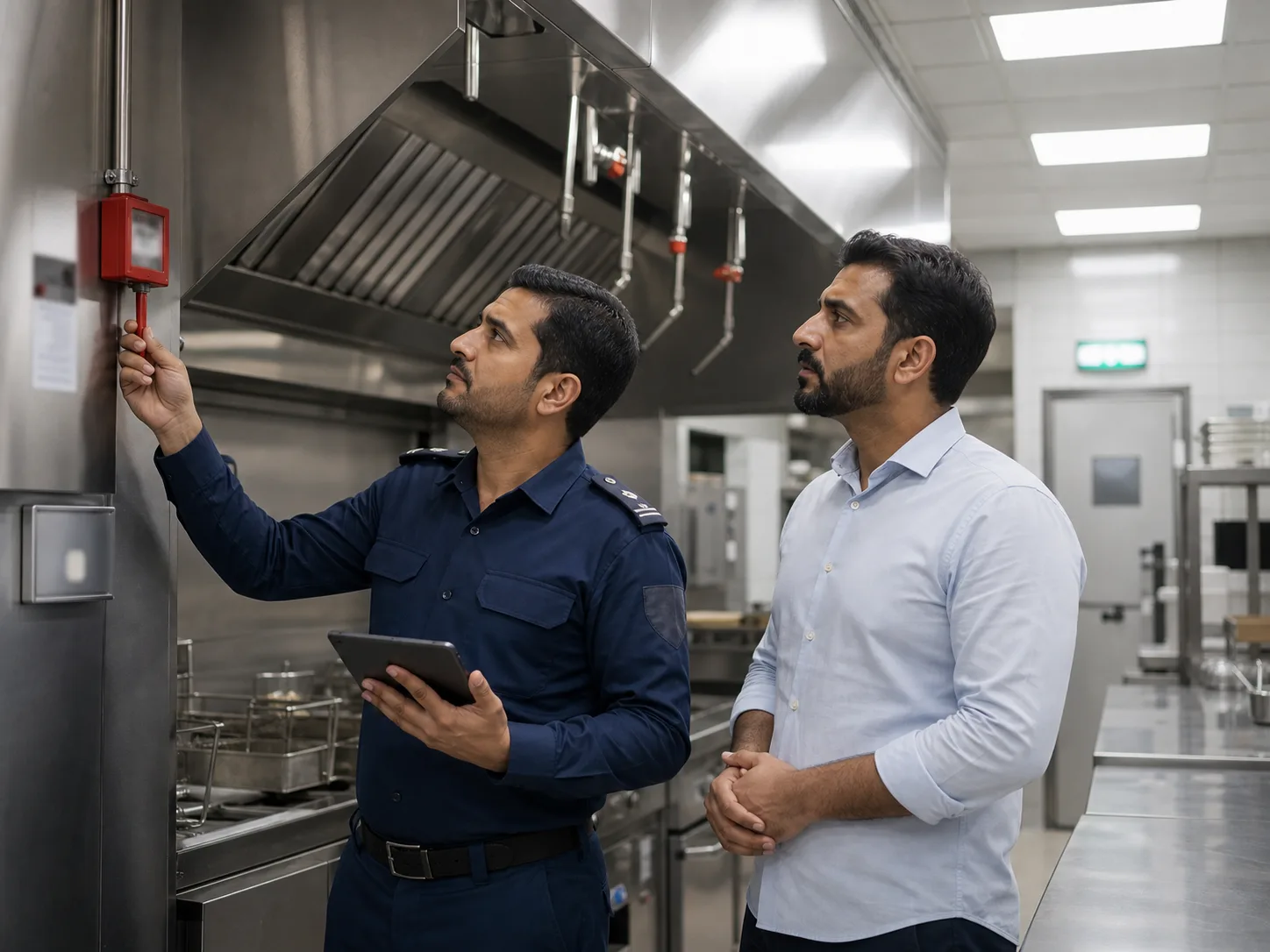
Every restaurant in Dubai needs Civil Defence (DCD) approval before fit-out and a passed inspection before opening — governed by the UAE Fire and Life Safety Code of Practice (current edition: September 2018) and enforced under UAE Cabinet Resolution No. 24 of 2012. Failing to comply ranges from a AED 10,000 fine for tampering with suppression equipment to administrative penalties of up to AED 2,000,000 under the restructured Dubai Civil Defence General Command (Law No. 4 of 2025).
This guide is for restaurant owners and GMs who want to know what DCD actually inspects, how the two-phase approval works, what numbers belong on your kitchen drawings, and what paperwork must be ready on inspection day. Everything below ties back to the Code or a primary source — no contractor folklore.
In this guide
- The two laws every Dubai operator must know
- Phase 1: Design approval before you fit out
- Phase 2: Site inspection and final NOC
- Kitchen-specific requirements DCD actually checks
- Egress, alarms, and Hassantuk Commercial
- Documents to keep on-site for inspection day
- Penalties: from AED 10,000 to AED 2,000,000
- The annual maintenance cycle
The two laws every Dubai operator must know
Dubai Civil Defence does not enforce a single restaurant-specific rulebook. Two instruments matter most:
- UAE Fire and Life Safety Code of Practice — the technical standard for everything physical: corridor widths, ductwork ratings, alarm circuitry, kitchen suppression. The current published edition is September 2018, maintained as a living document with amendments published as annexures on the DCD portal.
- UAE Cabinet Resolution No. 24 of 2012 — the enforcement instrument. This is the law behind the AED 10,000 fine for tampering with an automatic suppression system, behind the AED 50,000 fine when a facility lacks proper fire prevention during an incident, and behind the requirement to subscribe to the Hassantuk smart monitoring service.
Layered on top in Dubai is Law No. 4 of 2025, which restructured the Dubai Civil Defence General Command and lifted the ceiling on administrative fines to AED 2,000,000. At federal level, Federal Decree-Law No. 35 of 2024 introduces an additional disaster-period regime with penalties of AED 20,000 to 250,000 plus potential imprisonment. None of these supersede the Code — they tighten the consequences when the Code is ignored.
You don't need to memorise every page of the Code, but you should know which clauses your fit-out contractor and your fire contractor are citing — and demand the citation in writing when something looks off.
Phase 1: Design approval before you fit out
DCD approval is a two-phase process. Phase 1 is a paperwork phase: nothing physical is built, nothing is inspected, but no contractor should touch the shell until you hold the initial approval.
What's submitted, via the DCD online portal:
- Trade licence
- Tenancy contract or title deed
- Dubai Municipality-approved architectural drawings
- MEP layouts (mechanical, electrical, plumbing)
- No Objection Certificate from the landlord or developer
- Fire & Life Safety drawings, prepared by a DCD-approved consultant
Realistic timing: submission takes about a day; the file review runs roughly two weeks. DCD engineers cross-check the drawings against the Code. If anything is off — a corridor below 1,100 mm, a kitchen exhaust without proper compartmentation, a missing pre-discharge alarm on a gaseous system — the file comes back for resubmission, and the clock restarts. Two or three resubmission rounds for a non-standard restaurant fit-out is not unusual.
Phase 2: Site inspection and final NOC
Once installation is complete, you request inspection. An officer visits and tests the building under live conditions. The verification list inspectors work through includes:
- Fire alarm panel activated and signal transmission to the Hassantuk gateway verified
- Sprinkler heads, where present, cross-checked against the approved layout
- Fire pumps pressure-checked
- Kitchen hood suppression discharge tested (manual actuator confirmed at the required height)
- Emergency lighting confirmed to activate on power failure
- Exit signage legible from at least 30 metres at every change of direction
- Doors swing outward in the direction of egress
- Installation certificates present for fire alarm, firefighting equipment, and kitchen hood suppression
- Valid Annual Maintenance Contract (AMC) attached with a DCD-approved company
Pass the inspection, and the final completion certificate is issued. Fail any single item, and DCD issues a corrective notice — typical timeline for the entire phase, including re-inspection, is around one month. End-to-end, plan for roughly 1.5 months from first submission to final NOC for a clean run; six to nine months is not exceptional for a complex fit-out with multiple rejections.
Kitchen-specific requirements DCD actually checks
Commercial cooking is the highest-risk zone in any restaurant. The Code, aligned with NFPA 96 internationally, sets specific physical thresholds for the kitchen envelope.
| Element | Code-aligned requirement |
|---|---|
| Hood overhang | 150–300 mm beyond the cooking line on front and sides, depending on hood type |
| Hood mounting height | Typically 700–1,200 mm above the cookline |
| Manual actuator (kitchen suppression) | Installed 1,067–1,200 mm above finished floor level, on the path of egress |
| Wet chemical suppression agent | UL 300 or LPCB-certified, pre-engineered system from a DCD-approved supplier |
| Kitchen extract duct | Fire-rated wrap or enclosure providing 120 minutes minimum resistance |
| Kitchen-to-dining compartmentation | 2-hour fire-rated walls and floors; self-closing fire doors; firestopping at every service penetration |
| Gas supply | Solenoid valve interlocked with the hood suppression — agent discharge cuts the fuel supply automatically |
| Detection inside the kitchen | Heat detectors (not smoke), to prevent nuisance trips from cooking vapours |
| Portable extinguishers | Class K (wet chemical) within reach of cookline; CO₂ near electrical risks; dry-powder ABC in dining areas |
Three failures recur on real inspections: hood overhang short of the appliance footprint (typically saving 150 mm of countertop and losing the entire suppression coverage), duct wrap incorrectly labelled or untested at 120 minutes, and the gas solenoid wired to a different circuit than the suppression release. Each is a re-inspection trigger; none is a small fix once the kitchen is built.
Egress, alarms, and Hassantuk Commercial
Egress numbers are deterministic — the Code sets them, inspectors measure them, and there is no negotiation:
Above a certain occupancy load, voice evacuation in Arabic and English replaces conventional bell-only systems, and the Fire Alarm Control Panel (FACP) must sit in a central, accessible location — not buried behind a back-of-house door that staff cannot reach during a live alarm.
Then there is Hassantuk Commercial. Under Cabinet Resolution No. 24 of 2012, every commercial building in the UAE — restaurants included — must subscribe to the Hassantuk smart monitoring service. The restaurant's fire alarm panel is wired to a Hassantuk gateway that transmits alarm signals directly to a 24/7 operations room linked to Civil Defence. Operator-published material describes a signal transmission target of within 120 seconds of detection. The Ministry of Interior has stated publicly that Hassantuk had prevented over 400 real fire incidents by early 2024.
Some restaurants pass the initial inspection with a Hassantuk gateway installed but no live subscription. The certificate is conditional on an active subscription. Letting it lapse — typically because the bill goes to the landlord, the landlord changes hands, and the renewal is missed — converts a compliant restaurant into a non-compliant one without anything physical changing in the building.
Documents to keep on-site for inspection day
DCD inspectors ask for paperwork before they look at hardware. The minimum on-site file:
- Approved fire & life safety drawings — the version DCD signed off, not the latest contractor draft
- Installation certificates for the fire alarm, firefighting equipment, and kitchen hood suppression
- Valid Annual Maintenance Contract with a DCD-approved fire contractor
- Fire safety logbook with monthly functional test records and bi-annual maintenance entries
- Hassantuk Commercial subscription confirmation
- Staff fire drill records (typically two drills per year minimum)
- Food handler training records for kitchen staff — Dubai Municipality territory rather than DCD, but inspectors will check parallel compliance
- Trade licence and current tenancy contract
The logbook is the most often-failed line. A drawer of receipts is not a logbook. A DCD logbook reads like a maintenance journal: dated entries, named technician, parts replaced, panel events, fire drills conducted with attendance list. Restaurants that run a tight operations system already have the parallel for shift checklists, stock counts, and supplier invoices — the discipline is the same.
Penalties: from AED 10,000 to AED 2,000,000
Cabinet Resolution No. 24 of 2012 sets the baseline penalties most operators encounter, and Dubai Law No. 4 of 2025 raises the ceiling for what the restructured DCD General Command can impose administratively.
| Violation | Amount (AED) | Source |
|---|---|---|
| Tampering with an automatic fire suppression system (modify, disconnect, remove, cover) in a commercial building | 10,000 | Cabinet Resolution No. 24 of 2012 |
| Facility without proper fire prevention measures during an incident — plus liability for firefighting and rescue costs | 50,000 | Cabinet Resolution No. 24 of 2012 |
| Late DCD certificate renewal (operator-cited) | up to 50,000 | Operator guidance; consistent with Cabinet Resolution 24/2012 enforcement |
| Disaster-period civil defence violations | 20,000–250,000 (plus possible imprisonment ≥2 months) | Federal Decree-Law No. 35 of 2024 |
| Maximum administrative fine under the restructured Dubai Civil Defence General Command | up to 2,000,000 | Dubai Law No. 4 of 2025 |
On top of monetary fines, enforcement powers include immediate suspension of operations and disconnection of utilities. Dubai Civil Defence's published enforcement pattern is tiered: an inspector issues a notice; if uncorrected, a fine; if still uncorrected, suspension. The cheapest version of compliance is the one where you never reach step two.
The annual maintenance cycle
DCD compliance is not a once-and-done event. The annual cycle the Code expects from a restaurant:
- Monthly — functional test of the fire alarm system; visual check of extinguisher pressure gauges; logged in the on-site logbook
- Bi-annual — comprehensive maintenance by a DCD-approved contractor (NFPA 96 equivalent expects two full inspections of kitchen suppression per year); kitchen hood and duct grease cleaning
- Annual — renewal of the AMC; renewal of the DCD certificate; fire-extinguisher hydrostatic test cycle per manufacturer; staff fire drill (typically a minimum of two drills per year for restaurant occupancies)
- ≥30 days before expiry — start the DCD certificate renewal submission; late renewal puts the restaurant in the AED 50,000 zone and risks suspension
Treat the AMC as procurement, not a tick-box. The maintenance company holds the certificate and the documentation that's worth the most at renewal time. Switching contractors in the last 60 days of the cycle is the single most common reason restaurants miss renewal deadlines.
Frequently asked questions
Do I need Dubai Civil Defence approval to open a restaurant?
Yes. Every restaurant in Dubai needs a Civil Defence No-Objection Certificate (NOC) before fit-out and a final inspection clearance before opening. Operations relying on open flame, hot oil, gas, or commercial extraction are categorised as high-risk and are not exempt from any stage of the process.
How long does the full DCD approval take for a restaurant?
Around 1.5 months end-to-end is realistic for a clean run: one day to submit, roughly two weeks for design review, and about a month for installation, inspection scheduling, and the on-site visit. Resubmissions for incomplete drawings or non-compliant installations extend the timeline — a complex fit-out with two or three rejection cycles typically takes six to nine months.
Is Hassantuk mandatory for restaurants in Dubai?
Yes. Under UAE Cabinet Resolution No. 24 of 2012, commercial buildings — including restaurants — must subscribe to the Hassantuk smart fire monitoring service, which transmits alarms directly to Civil Defence operations rooms. The restaurant's fire alarm control panel must be wired to the Hassantuk gateway.
What is the fine for tampering with a restaurant's fire system?
Modifying, disconnecting, removing, or covering components of an automatic fire suppression system in a commercial building carries an AED 10,000 fine under Cabinet Resolution No. 24 of 2012. A facility caught without proper fire prevention equipment during an incident faces an AED 50,000 fine plus liability for firefighting and rescue costs.
Does HoreX install or certify fire safety systems?
No. HoreX is restaurant management software — POS, KDS, inventory, recipes, finance. Fire suppression, alarm, and Hassantuk integration must be installed and certified by Dubai Civil Defence approved contractors, who hold the design responsibility and the Annual Maintenance Contract. HoreX sits next to that as your daily operational record system.
When should I renew the DCD certificate to avoid fines?
Begin the renewal at least 30 days before certificate expiry, with a valid Annual Maintenance Contract (AMC) from a DCD-approved fire contractor already in place. Late renewal can lead to fines reaching AED 50,000 and suspension of operations under Dubai Civil Defence enforcement powers.
Sources
- Dubai Civil Defence — UAE Fire and Life Safety Code of Practice (landing page)
- UAE Fire and Life Safety Code of Practice (PDF, dcd.gov.ae)
- UAE Ministerial Resolution No. (505) of 2012 — Ministry of Interior
- Dubai Law No. 4 of 2025 — Establishing the Dubai Civil Defence General Command (PDF)
- Gulf News — Dh10,000 fine for tampering with fire safety systems (Cabinet Resolution 24/2012)
- The National — Dubai Civil Defence expects Hassantuk in all villas by end of 2024
- Hassantuk — Ministry of Interior official portal
- Klima Global — Kitchen Hood Design Guide for UAE & MENA (code-aligned dimensions)