Dubai Municipality Food Safety — The 2026 Guide
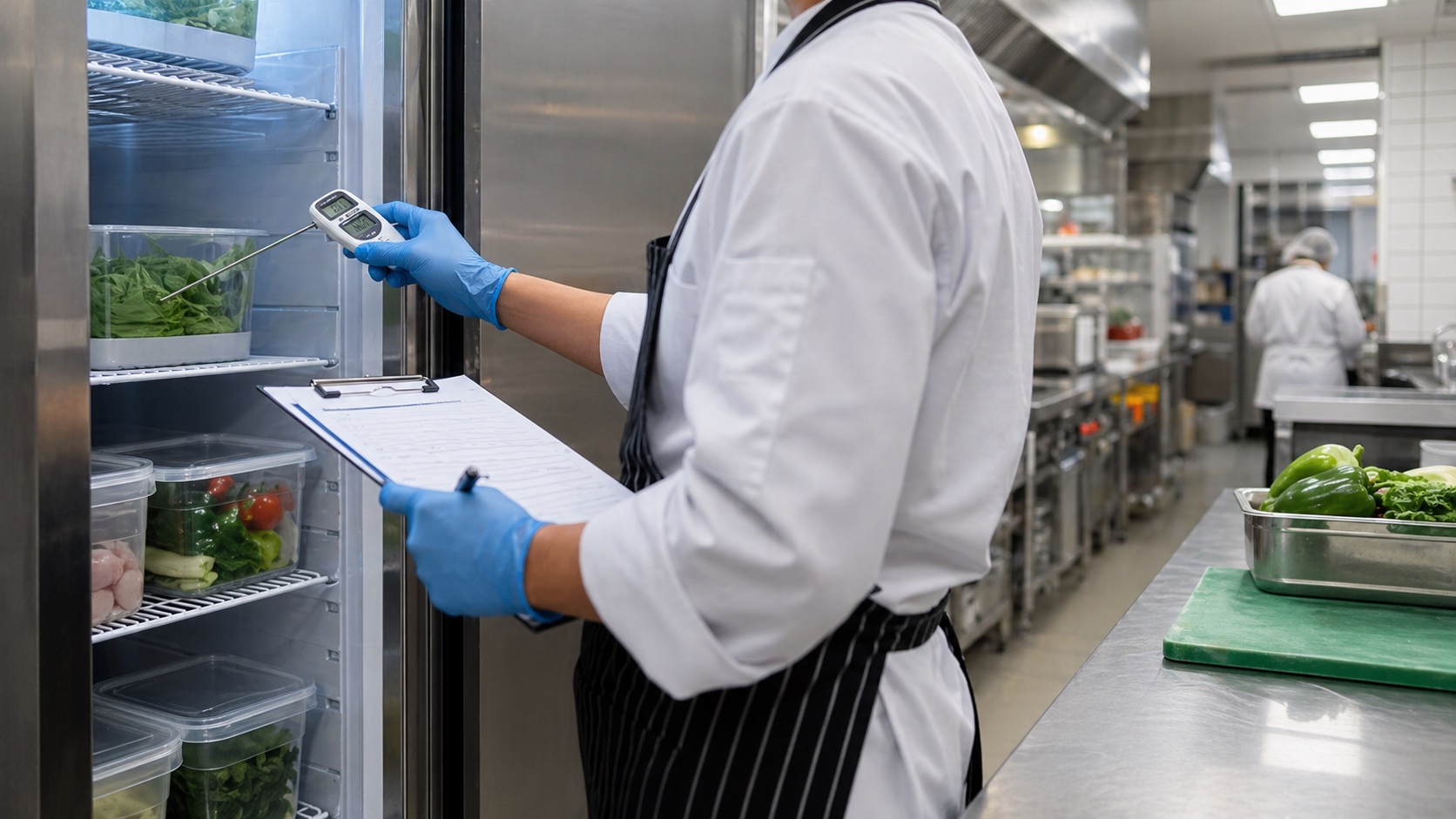
Every food business in Dubai — from a single-outlet café to a 20-branch chain — must comply with Dubai Food Code 2.0, published by Dubai Municipality's Food Safety Department in July 2023. The code applies to more than 25,000 establishments and over 300,000 food handlers, and its penalty schedule tops out at AED 2 million plus imprisonment for serving unsafe food.
This guide walks through every mandatory requirement an operator needs to know: permits and their real costs, the A-to-F grading system, HACCP documentation, food-handler training (AED 199 per person), temperature rules, and the penalty schedule — with the primary DM source cited for each.
In this guide
- Dubai Food Code 2.0 — what changed in 2023
- Food establishment permit & costs
- The A-to-F grading system
- Temperature control — the top failure point
- Food handler training — who, what, how much
- Person in Charge on every shift
- HACCP & third-party audit
- What's new in Food Code 2.0
- Penalties — what non-compliance costs
- DMChecked — Dubai's compliance platform
- How restaurant software helps with DM compliance
- FAQ
Dubai Food Code 2.0 — What Changed in 2023
The Dubai Food Code is the master compliance document for every food business in the Emirate, consolidating local legislation, Codex Alimentarius standards, and UAE-specific requirements into a single enforceable reference (Dubai Municipality, Food Safety Department).
The current version — Food Code 2.0, released in July 2023 — is the first major rewrite in over a decade. It applies to more than 25,000 food businesses and affects over 300,000 food handlers across Dubai.
Key changes introduced by Food Code 2.0:
- Mandatory declaration of 14 specific allergens on menus — stricter than the previous general statement
- Validation of organic, healthy, and gluten-free claims during inspections (evidence required)
- New regulations for novel techniques: ageing, smoking, lab meat, raw ready-to-eat foods
- Updated delivery-vehicle food safety standards, coordinated with RTA
- Requirement for high-touch surfaces to be disinfected every 30 minutes during service
The new code pushes food businesses to identify their own problems and work on them proactively — without someone telling them what to do. Dubai Municipality Food Safety Department (via Gulf News, 2023)
Food Establishment Permit & What It Costs
Before opening a restaurant in Dubai, you need two parallel approvals: a trade license from the Department of Economic Development (DED) and a food establishment permit from Dubai Municipality. Neither replaces the other.
The licensing process
- Obtain DED trade license (or free-zone equivalent)
- Register the establishment on DMChecked (dmchecked.dm.gov.ae) — Dubai Municipality's current compliance platform
- Submit a Food Safety Plan documenting your HACCP / FSMS approach
- Pass the DM pre-opening inspection
- Receive the Food Safety Certificate — valid 1 year, annually renewable
Permit costs (2025–2026)
| Permit / fee | Cost (AED) |
|---|---|
| DED trade license (mainland restaurant) | 10,000 – 25,000 / year |
| Dubai Municipality food safety license | 10,000 – 15,000 |
| Kitchen / layout design approval | 500 – 1,000 |
| Annual Food Safety Certificate renewal | Included in DM permit |
All applications, renewals, and compliance documents are managed through DMChecked (dmchecked.dm.gov.ae) — Dubai Municipality's unified food safety platform, which replaced the earlier FoodWatch system. Businesses previously registered on FoodWatch were migrated automatically.
The A-to-F Grading System — From Gold Card to Red Card
After every inspection, Dubai Municipality assigns a grade to your establishment. The grade is public — customers can check it through DMChecked — and directly controls how often inspectors return (Dubai Municipality).
| Grade | Meaning | Inspection frequency |
|---|---|---|
| A — Gold Card | Impeccable food safety standards | Once per year |
| B — Green Card | Commendable; room for improvement | Every 6 months |
| C | Acceptable; needs focus | More than every 6 months |
| D — Orange Card | Poor; immediate corrective action required | Escalated |
| F — Red Card | Severely compromised; closure risk | Immediate |
Temperature Control — The Top Failure Point
Temperature mismanagement is consistently among the top reasons Dubai restaurants fail DM inspections. The Dubai Food Code specifies these mandatory thresholds:
| Storage / service | Required temperature |
|---|---|
| Refrigeration (chilled food) | ≤ 5°C |
| Freezer storage | ≤ -18°C |
| Hot food holding (service) | ≥ 60°C |
| Cooking core (raw animal origin) | ≥ 75°C |
| Cooling after cooking | 60°C → 20°C in 2 h, then 20°C → 5°C in 4 h (total 6 h) |
| Reheating for hot hold | to ≥ 75°C core, passing 5-60°C within 1 h |
| Temperature danger zone | 5°C – 60°C (avoid extended exposure) |
Beyond hitting these numbers, Food Code 2.0 requires that temperature logs are:
- Recorded for every fridge, freezer, and hot-hold unit, every shift
- Uploaded to DMChecked — not kept on paper clipboards that inspectors may never review
- Supported by calibrated thermometers with calibration records on file
Deliveries from suppliers must also include temperature documentation, and receiving staff must check and record delivery temperatures. Only DM-approved suppliers registered in DMChecked are permitted — purchasing from non-registered vendors is a violation regardless of product quality.
Food Handler Training — Who, What, How Much
Every person who handles food in Dubai — in restaurants, cafes, hotels, catering companies, food warehouses, school canteens — must hold a valid food safety certificate from a DM-approved training provider.
What the training covers
- Food safety law and Dubai-specific legislation
- Biological, chemical, and physical food hazards
- Temperature danger zone and time-temperature control
- Cross-contamination prevention
- Allergen management (expanded under Food Code 2.0)
- Cleaning, disinfection, pest control, waste disposal
Training details
| Detail | Requirement |
|---|---|
| Duration | 1 full day (9:00 – 16:00 typical) |
| Exam | 35 multiple-choice questions |
| Minimum passing score | 75% |
| Cost per participant | AED 199 (SaveFast); AED 100–300 across providers |
| Certificate validity | 1–2 years (varies by provider) |
For a restaurant with 20 food handlers, minimum annual training cost is roughly AED 4,000 – 6,000 depending on provider and renewal frequency. Inspectors check staff certificates individually during audits — a missing certificate is a finding.
Person in Charge — The Compliance Anchor on Every Shift
Beyond basic food-handler training, the Dubai Food Code requires every food business to designate at least one Person in Charge (PIC) trained to a higher standard and present on every shift.
- PIC certification is valid for 5 years (subject to withdrawal for non-compliance)
- The PIC is responsible for updating DMChecked records daily
- Every shift — morning, afternoon, evening — must have a certified PIC physically present
- For multi-outlet chains, each location requires its own PIC coverage
The PIC model mirrors the manager-certification approach used in the US (ServSafe) and UK (Level 3 Food Safety) but with Dubai-specific regulatory anchors. Many UAE restaurants appoint a senior chef or floor manager as PIC and rotate responsibility across qualified staff.
HACCP & The Third-Party Audit Requirement
Hazard Analysis and Critical Control Points (HACCP) is not optional for high-risk food operations in Dubai — it is a mandatory documented system. Food Code 2.0 requires a formal Food Safety Management System (FSMS) based on either HACCP principles or ISO 22000.
The 7 HACCP principles (as applied in Dubai)
- Hazard analysis — identify biological, chemical, physical hazards at each process step
- Critical Control Points — cooking temps, chilling rates, cross-contamination risk points
- Critical limits — temperature thresholds and time limits per the Food Code
- Monitoring system — who checks what, how often, logged in DMChecked
- Corrective actions — documented response when a CCP is breached
- Verification procedures — internal audits and thermometer calibration
- Documentation — all records retained for inspection
What's Operationally New in Food Code 2.0
Food Code 2.0 was published in July 2023, and many of its new provisions — particularly around allergen labelling and claims validation — are actively enforced during inspections today. Here's what's new in practice:
Allergen declaration (14 mandatory allergens)
Dubai now requires declaration of 14 specific allergens on menus, mirroring the EU's mandatory list. This goes beyond a general "contains nuts" statement — each dish must have its allergen profile documented and available to customers on request. For chains, menus must be updated across all locations and allergen records maintained per recipe.
Claims that a dish is gluten-free, dairy-free, or suitable for specific allergens require supporting documentation, not just a menu label.
Organic and health claims — evidence required
If your menu says "organic ingredients," DM inspectors can now demand proof during inspections — supplier invoices and certification documents showing certified-organic sourcing, not just marketing copy on the menu.
Novel cooking techniques
Techniques including dry ageing, cold smoking, house-curing, and serving raw or partially cooked proteins (sashimi, tartare, medium-rare poultry) now require specific documented protocols. Establishments using these techniques must have DM-approved procedures on file.
Surface disinfection
High-touch surfaces must be disinfected every 30 minutes during service — prep counters, handles, equipment knobs, shared touch points. Only DM-approved biocides are permitted.
Penalties — How Much Non-Compliance Actually Costs
The Dubai Food Code penalty schedule ranges from manageable to business-ending. These figures come from the enforcement framework documented by Dubai Municipality:
| Violation | Penalty |
|---|---|
| Serving unsafe, adulterated, or contaminated food | AED 100,000 – 2,000,000 and/or imprisonment |
| Selling unlicensed pork or alcohol | AED 50,000 – 500,000 and/or imprisonment |
| Mislabelling, false health or organic claims | AED 10,000 – 100,000 |
| Ignoring a food-safety incident or recall | Temporary closure or license suspension |
| Purchasing from non-DM-approved suppliers | Violation; escalated penalty on repeat |
| Consecutive D or F inspection grades | Mandatory 1-week closure of all activities |
| Repeat violations (any category) | Doubled fines; escalated legal action |
The AED 2 million fine isn't theoretical — it applies to cases where contaminated food causes public harm. In practice, a single foodborne-illness outbreak traced to a restaurant can simultaneously trigger a fine, temporary closure, media coverage, and civil liability.
DMChecked — How Dubai's Digital Compliance Works
Dubai Municipality's compliance infrastructure is digital-first. The current platform is DMChecked (dmchecked.dm.gov.ae), which replaced the earlier FoodWatch system. DMChecked is a mobile-and-web application used by restaurant managers, PICs, and DM inspectors to record, track, and verify compliance in real time.
What food businesses manage in DMChecked:
- Temperature and cleaning logs — uploaded digitally every shift, not on paper
- Staff food-handler certificates and renewal tracking
- Supplier verification — is a supplier DM-registered before you place an order
- Permit applications and Food Safety Certificate renewals
- Pest-control service reports
- Third-party audit reports (retained on platform for 4-year inspection window)
DMChecked also enables remote video inspections and real-time compliance checks by DM inspectors — meaning a DM officer can audit your digital records without being physically on-site. Businesses previously registered on the older FoodWatch platform were migrated to DMChecked automatically.
The PIC is responsible for maintaining DMChecked records daily. Incomplete digital records are treated as a compliance gap — even when the physical kitchen is spotless.
How Restaurant Management Software Helps With DM Compliance
Meeting DM requirements manually — spreadsheet temperature logs, paper HACCP checklists, emailed supplier invoices — creates gaps that inspectors find. The operational overhead also consumes management time that should go toward hospitality.
A purpose-built restaurant management platform handles several compliance touchpoints automatically:
- Inventory management — real-time stock balances, movement history, par-level alerts, and supplier-linked purchase orders — the receiving paper trail inspectors ask for
- Invoice AI — OCR scans supplier invoices in Arabic or English, three-way matches them against PO and delivery, and posts to stock and finance in one flow
- Recipe cards — structured recipes with brutto/netto weights, full ingredient lists, and multi-level semi-finished products — a defensible ingredient record per dish when inspectors ask about allergen composition
When DM asks "show me your receiving logs for the last 4 months," teams using integrated software pull a report in minutes. Teams using WhatsApp and Excel spend hours reconstructing records — or can't produce them at all.
Frequently asked questions
What are the minimum food safety requirements for restaurants in Dubai?
Every Dubai restaurant must comply with Dubai Food Code 2.0 (July 2023). Core requirements: a valid DM food establishment permit, all staff completing DM-approved Basic Food Safety Training, a certified Person in Charge on every shift, a documented HACCP or ISO 22000 food safety management system, and active daily use of DMChecked — Dubai Municipality's current digital compliance platform — for temperature logs, staff records, and supplier tracking.
How much does DM food handler training cost?
Basic Food Safety Training approved by Dubai Municipality costs AED 199 per participant at SaveFast. The course runs one full day (9am–4pm), covers law, hazards, temperature control and allergens, and requires passing a 35-question exam at a minimum 75% score. Prices across DM-approved providers range AED 100–300.
What is Dubai Municipality's restaurant grading system?
DM grades establishments on a five-level scale: A (Gold Card) — impeccable, inspected yearly; B (Green Card) — commendable, every 6 months; C — acceptable, more than every 6 months; D (Orange Card) — poor, immediate corrective action; F (Red Card) — severely compromised, closure risk. Consecutive D or F grades trigger a mandatory 1-week closure.
What temperatures must Dubai restaurants hold food at?
The Dubai Food Code requires: refrigerators at ≤ 5°C, freezers at ≤ -18°C, hot food holding at ≥ 60°C, and cooking raw animal-origin food to core ≥ 75°C. The temperature danger zone 5°C–60°C is where bacteria multiply — high-risk foods must not sit there for more than 2 hours (hot) or 4 hours (cold). Cooling follows a 60→20°C in 2 h / 20→5°C in 4 h rule. All readings must be logged digitally in DMChecked.
What are the penalties for failing a Dubai Municipality food inspection?
Penalties range from AED 10,000 (mislabelling) to AED 100,000 – 2,000,000 and/or imprisonment for serving adulterated food. Consecutive D or F grades result in mandatory 1-week closure. Repeat violations carry doubled fines and can escalate to permit revocation.
What does Food Code 2.0 require that the previous code did not?
Food Code 2.0 (July 2023) adds: mandatory declaration of 14 allergens on menus; proof for organic and health claims; documented protocols for novel cooking techniques (ageing, smoking, raw ready-to-eat); updated delivery-vehicle standards with RTA; and disinfection of high-touch surfaces every 30 minutes using DM-approved biocides only.
Sources
- Dubai Municipality — Food Safety Department — dm.gov.ae
- Dubai Food Code 2.0 (Version 12, July 2023) — Dubai Municipality official PDF — Full document
- DMChecked Platform — Dubai Municipality — dmchecked.dm.gov.ae
- Gulf News — "What upcoming Food Code 2.0 means to you" (June 2023) — gulfnews.com
- Dubai Department of Economic Development — Trade licensing — ded.ae
- SaveFast — Basic Food Safety Training DM (DM-approved provider) — sfast.ae
- Codex Alimentarius — General Principles of Food Hygiene — fao.org/codexalimentarius