Restaurant Kitchen Design Requirements in Dubai 2026
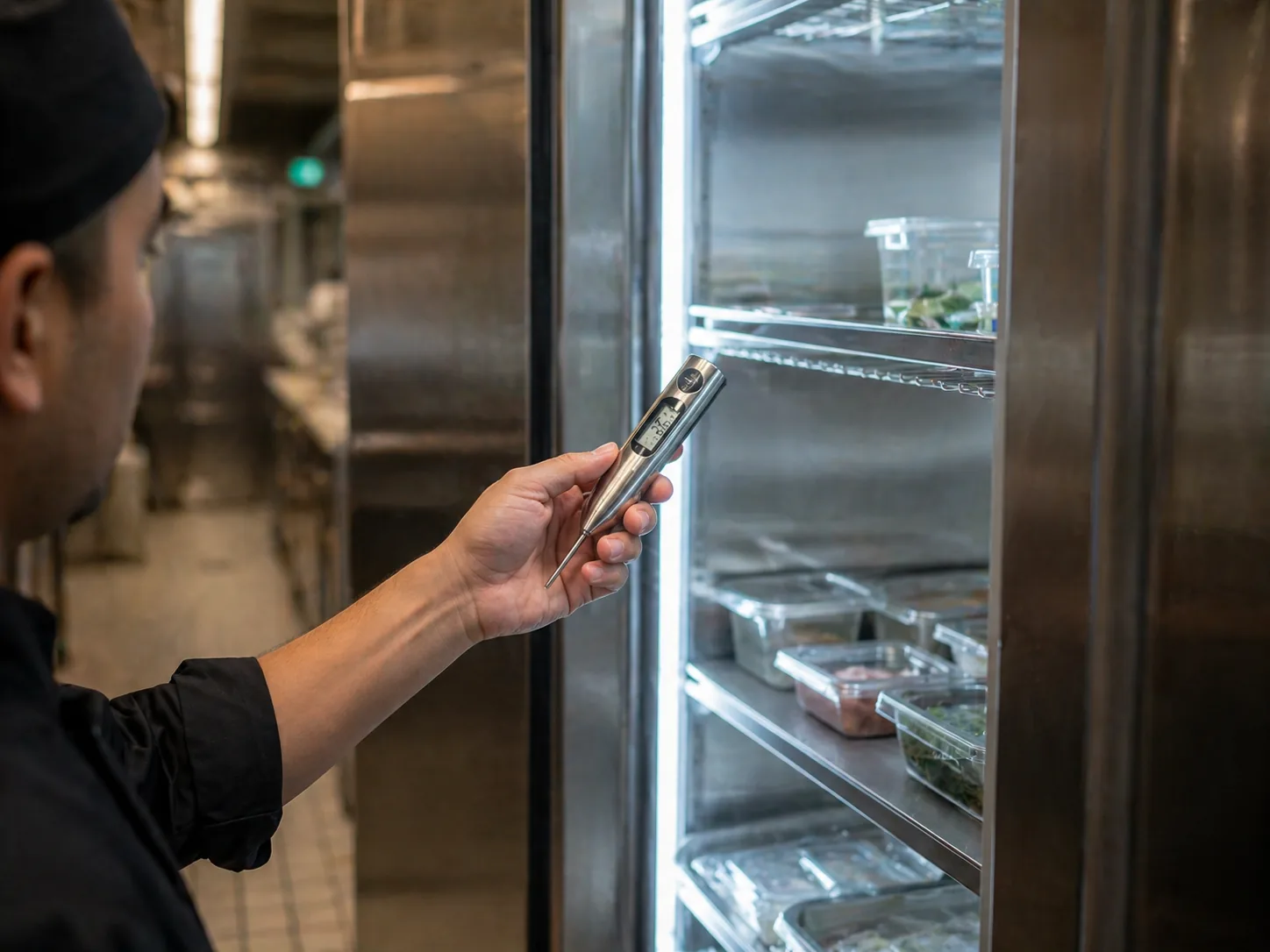
A restaurant kitchen in Dubai must be designed to satisfy Food Code 2.0, the UAE Fire and Life Safety Code, and the Dubai Municipality plan-approval process — long before construction starts. The Food Safety Department reviews the floor plan first; the build then has to meet specific rules on flow, surface materials, lighting (110–500 lux), mechanical ventilation, hood fire suppression and hand-wash placement. Get the layout wrong and the trade licence is held until it is fixed.
This guide walks through every layout-stage requirement that applies to a new or renovated restaurant kitchen in the Emirate of Dubai (~26,000+ licensed food establishments as of 2023, per Food Code 2.0 §1.1). Every clause cited below comes from the live Dubai Municipality Food Code 2.0 (Final Draft, version 12, July 2023) or from the UAE Fire and Life Safety Code of Practice. Use it as the brief you give your designer and MEP contractor before drawings go to DM for approval.
In this guide
- Plan approval — the layout-stage gate
- Layout, flow and spatial requirements
- Floors, walls, ceilings and drains
- Lighting — three lux thresholds
- Ventilation, hoods and exhaust cleaning
- Hand-wash, toilets and dressing rooms
- Civil Defence: kitchen fire suppression
- Pre-handover compliance checklist
- Frequently asked questions
Plan approval — the layout-stage gate
Before any construction or renovation, the proposed floor plan must be submitted to and approved by the Dubai Municipality Food Safety Department (Food Code 2.0 §2.2.a). This is the gate. A trade licence from the licensing authority — DET, DAFZA, JAFZA, DDA, DMCC, DIFC or another (§1.6 Definitions) — does not, by itself, allow you to start building a kitchen.
The scaled drawing must show:
- area allocated to food handling, cooking, cleaning, preparation, storage and seating;
- sanitary fitments, restrooms, storage areas and the area for cleaning chemicals and tools;
- all windows and the mechanical ventilation system;
- location of equipment and facilities for handwashing, cleaning and food preparation;
- all means of exit and entry.
Major alterations to an existing kitchen — adding or removing food areas, changing the process flow, swapping equipment that forms part of the licensed activity — also require prior approval (§2.2.b). Adding shelves to a dry store does not.
The most common rejections are: bidirectional food flow (raw and ready-to-eat crossing each other), a toilet that opens into the prep area, an undersized changing/locker space, no dedicated chemical storage, or a hand-wash sink missing from a food prep area that handles open food. These are layout issues — fixing them after walls are built is expensive.
Layout, flow and spatial requirements
Food Code 2.0 §2.4.b requires a unidirectional flow:
receiving → storage → preparation → cooking → packaging / serving / dispatch.
Food and clean utensils must not be conveyed through an open space or open yard that would expose them to contaminants. Toilets, clean-up areas and chemical storage must be physically separated from food preparation and processing.
On spatial requirements, Food Code 2.0 §2.5 deliberately does not give a fixed minimum kitchen area in m². The rule is that space must be sufficient for receiving, preparation, packaging, holding, serving, equipment storage, biocides, waste handling and staff changing rooms — sized to the type and volume of food, the equipment used, and the number of staff working simultaneously. A small kitchen serving high-volume hot food can be rejected even at the same square footage where a cold-prep kitchen would have been approved.
The Code also flags siting (§2.3): a recommended minimum distance of 30 metres from waste-disposal facilities or other contamination sources, and a minimum 10-metre clean buffer around the establishment along streets, lanes and common areas of the building.
Food Code 2.0 §2.6.3 explicitly notes that warm Dubai weather requires year-round air conditioning, and that exterior openings hinder cooling. Where possible, design without external windows or doors directly onto the kitchen. Where unavoidable, install solid self-closing tight-fitting doors, self-closing screen doors or properly designed air curtains to keep pests out.
Floors, walls, ceilings and drains
Floors in wet areas (food preparation, walk-in chillers, washrooms, anywhere subject to flushing or spray cleaning) must be light-coloured, durable, easily cleanable, non-slip, and constructed of impervious material such as flooring tile or resin able to withstand wet washing and steam cleaning (§2.6.1.b). Wall-to-floor joints must be coved and sealed; the floor must be sloped to prevent pooling of liquids. The Code recommends a minimum slope of 2% to drain. Carpet, cardboard, newspaper, sponge and unsuitable rubber mats are prohibited as floor materials.
Walls in areas where open food is handled must be surfaced with smooth, preferably light-coloured, durable, non-absorbent and easily cleanable material — for example tile or stainless steel — to a height of not less than 2 metres (§2.6.2.a.iii). Above 2 m, light-coloured paint is acceptable. Wall-to-wall and wall-to-floor junctions must be coved.
Ceilings must be of continuous construction with no empty spaces or wide joints, light-coloured and fireproof (§2.6.2.b). Condensation and mould must be designed out. False ceilings, if used, need smooth, easily cleanable, impervious surfaces and access openings to clean above them.
Floor drains must flow from high-care to low-care areas, not the other way (§2.6.4.d). Lines must be sloped, properly trapped, vented and connected to the proper drainage system, with no cross-connection between drain lines and water-supply lines. Where oil or fat enters wastewater, a grease trap is mandatory (§2.13), of a type approved by Dubai Municipality, emptied and cleaned at specified intervals by an approved collection company.
Lighting — three lux thresholds
Food Code 2.0 §2.8.b sets three explicit minimum lighting intensities, measured at 89 cm / 3 ft above the floor unless specified otherwise. This is the table to give your electrical contractor.
| Area | Minimum lux | Reference |
|---|---|---|
| Walk-in chillers, dry food storage, all areas during cleaning | 110 lux | §2.8.b.i |
| Fresh produce / packaged-food sales floor; hand-wash and ware-wash; equipment and utensil storage; toilet rooms | 220 lux | §2.8.b.ii |
| Surface where a food handler works with unpackaged high-risk foods or with knives, slicers, grinders, saws | 500 lux | §2.8.b.iii |
Wherever lighting fixtures could expose food, equipment, utensils, linens or unwrapped packaging to broken glass, the fixtures must be shatterproof or shielded with shatterproof covers (§2.8.c). Shielding is not required in storerooms holding only sealed packaged food.
Ventilation, hoods and exhaust cleaning
Mechanical or mixed-mode ventilation is mandatory in every food establishment to keep indoor air quality acceptable (Food Code 2.0 §2.9.a). The design and installation must follow the requirements set by the Dubai Municipality Health and Safety Department.
Specifically, the ventilation system must (§2.9.c):
- be sufficient in number and capacity to prevent grease or condensation building up on walls and ceilings;
- have grease-extracting equipment with filters that are easily removable for cleaning, or designed for clean-in-place;
- have hoods, fans, guards and ducting that prevent grease or condensation from draining or dripping;
- include make-up air systems installed per DM requirements;
- not create a public health hazard, nuisance or unlawful discharge when vented outside;
- have an air intake located away from any source of contamination.
In high-care food facilities, airflow must be directed from clean to contaminated areas, not the reverse (§2.9.d). The kitchen operates under negative pressure relative to the dining room — that is the design intent your MEP must deliver.
Two cleaning intervals are written into the Code:
- Hood grease-trapping filters — inspected at least once a month, cleaned or replaced as needed (§2.9.f).
- Kitchen hood and exhaust plenum — professionally cleaned at least once a year by a Dubai-Municipality-approved cleaning company, more often if grease build-up warrants (§2.9.g).
Hand-wash, toilets and dressing rooms
In any facility that handles open food, at least one hand-wash station must be provided in each food preparation area (Food Code 2.0 §2.17.b). Each hand-wash station must (§2.17.d):
- be conveniently located and accessible to all food handlers and other workers;
- be equipped with liquid soap and single-use paper hand towels and/or hand dryers;
- provide an adequate flow of water at a temperature that is neither too hot nor too cold;
- be easily cleanable and maintained in a clean condition;
- carry clear signage and be reserved for hand-washing — no other purpose.
For toilets (§2.18.a):
- completely enclosed, with tight-fitting self-closing doors;
- each toilet has a hand-wash station with liquid soap, single-use towels or hand dryers, and signage;
- well-ventilated and well-lit;
- the toilet shall not open directly into any food area where food or packaging material is stored, handled or packed;
- where a toilet is adjacent to a food area, separation must include a double door and a ventilated space between toilet and food area.
If staff change clothes on the premises, dressing and changing areas are mandatory and must be easily cleanable, well-ventilated, well-lit, and provided with lockers — separated by gender as far as practicable (§2.18.c). A separate dining area for staff meals must be hygienic, ventilated, and completely separated from any work process (§2.18.d).
Civil Defence: kitchen fire suppression
The UAE Fire and Life Safety Code of Practice (issued by Dubai Civil Defence) requires every commercial cooking operation to install an automatic kitchen-hood fire suppression system that meets UL 300 and NFPA 96. These are wet-chemical systems engineered for Class K fires — burning cooking oils and fats — which standard water or dry-chemical extinguishers cannot effectively suppress.
What the system has to deliver:
- Coverage — discharge nozzles over every cooking surface that produces grease-laden vapour (fryers, ranges, grills, charbroilers, woks, salamanders) plus the exhaust hood and ductwork;
- Approved agent — wet-chemical agent listed by the Emirates Authority for Standardization and Metrology (ESMA);
- Activation — automatic detection (heat sensors / fusible links) plus a mandatory manual pull station as backup, located on the egress path out of the kitchen;
- Interlocks — automatic shut-off of gas, electric power to the appliances, and the exhaust fan upon discharge;
- Installation — performed by a Dubai-Civil-Defence-certified fire contractor;
- Service — recharge and inspection within 24 hours of any discharge by a DCD-licensed contractor; periodic servicing thereafter under an Annual Maintenance Contract.
Fire-rated ductwork (typically a 2-hour rating per the UAE Fire Code) is required for vertical and horizontal kitchen exhaust runs that pass through other occupancies. Plan the duct route early — re-routing afterwards is the most expensive change a kitchen project ever makes.
Pre-handover compliance checklist
Run through this before requesting a final inspection. If a single line is "no", expect a hold.
Approvals. DM Food Safety Department layout approval on file. Civil Defence inspection booked or completed. Trade licence activities match what is being built.
Surfaces. Walls smooth, light-coloured, washable to ≥ 2 m. Floor coved at all wall junctions, sloped to drain. Ceiling continuous, light-coloured, fireproof. No exposed absorbent materials.
Equipment. Fixed equipment sealed to floor / wall or positioned with access for cleaning underneath. No painted food-contact surfaces. Hood is UL 300 / NFPA 96 with manual pull station and gas + electrical interlock.
Storage. All shelving ≥ 15 cm above the floor and ≥ 20 cm from the wall (§2.10.b). Chemicals in a lockable area separated from food and food-contact materials.
Lighting. 110 / 220 / 500 lux verified by meter at the prescribed locations. All fixtures over open food are shatterproof or shielded.
Ventilation. Make-up air installed. Filters fitted and accessible. Annual hood-cleaning contract with a DM-approved company in place.
Hand-wash & toilets. Hand-wash sink in each food prep area, with soap and single-use towels. No toilet opens directly into a food area; double-door + ventilated lobby where adjacent.
Water & drains. Water source from DEWA or licensed supplier; tank-cleaning contract twice a year with a DM-approved company. Grease trap installed on the kitchen drain line.
Records. Calibration records for every temperature gauge (interval ≤ 1 year, by an EIAC-accredited provider, §2.7.4).
For the inspection itself and what auditors test against operationally, see our HACCP checklist for UAE restaurants. For the broader picture of food-safety obligations beyond layout, see Dubai Municipality food safety requirements. If the kitchen is part of a brand-new restaurant rather than a renovation, our step-by-step Dubai opening checklist sequences the licences and approvals around it.
One last note on operations. Food Code 2.0 §2.10 requires that all food and food items be stored on shelves a minimum of 15 cm off the floor and at least 20 cm clear of walls. That is a layout constraint and an inventory constraint at the same time — the racks have to fit, and the receiving team has to keep them populated correctly. HoreX Inventory handles the second half: real-time stock balances by warehouse, par-level alerts, FIFO and expiry-date tracking, and inventory counts with variance analysis when something does not match what the recipes say it should be.
Frequently asked questions
Does Dubai Municipality set a minimum kitchen size in square metres?
Food Code 2.0 §2.5 does not prescribe a fixed minimum in m². The rule is that space must be sufficient for the activity — receiving, preparation, processing, packaging, holding, equipment storage, biocides storage, waste, and staff changing rooms. The Food Safety Department evaluates each layout case-by-case based on type of food, processes, equipment, output volume and the number of people working at the same time.
A small kitchen serving high-volume hot food will be rejected even if a larger kitchen serving cold prep would have been approved at the same area.
When does a Dubai restaurant need DM Food Safety Department approval of the layout?
Before construction, renovation or re-construction begins (Food Code 2.0 §2.2.a). The same approval is required for any major alteration that affects the main layout or process flow — adding food areas, removing equipment that is part of the licensed activity, or changing the unidirectional flow.
Minor edits like extra shelving in a storeroom do not need prior approval (§2.2.b–c).
What lighting levels does Food Code 2.0 require in a commercial kitchen?
Three thresholds (Food Code 2.0 §2.8.b), measured at 89 cm / 3 ft above the floor:
- 110 lux in walk-in chillers and dry storage, and in any area during cleaning;
- 220 lux in hand-wash, ware-wash, equipment storage and toilets;
- 500 lux at the surface where a food handler works with unpackaged high-risk food, knives, slicers, grinders or saws.
Lighting fixtures over food, equipment or utensils must be shatterproof or shielded.
Is a UL 300 fire suppression system mandatory in Dubai kitchens?
Yes. The UAE Fire and Life Safety Code of Practice requires every commercial cooking operation to install an automatic wet-chemical kitchen-hood fire suppression system meeting UL 300 and NFPA 96 — covering all cooking surfaces (fryers, grills, ranges) and the exhaust hood. The system must use ESMA-approved wet-chemical agents, integrate with automatic gas and electrical shut-off, and include a manual pull station as backup.
Installation must be performed by a Dubai Civil Defence-certified contractor and the system must be recharged within 24 hours of any discharge.
How often must the kitchen exhaust hood be cleaned?
Grease-trapping filters in the kitchen-hood exhaust must be inspected at least once a month and cleaned or replaced as required (Food Code 2.0 §2.9.f). The kitchen hood and the exhaust plenum must be professionally cleaned at least once a year by a cleaning company approved by Dubai Municipality (Food Code 2.0 §2.9.g) — more often if grease accumulation warrants.
Can a restaurant toilet open directly into the kitchen?
No. A toilet shall not open directly into a food area where food or packaging material is stored, handled or packed (Food Code 2.0 §2.18.a.v). When a toilet is adjacent to a food area, the separation must include a double door and a ventilated space between them (§2.18.a.vi).
Public-access toilets, if provided inside the food establishment, must be completely enclosed and separated from food preparation and storage areas.
Sources
- Dubai Municipality, Food Code 2.0 (Final Draft, version 12, July 2023) — operational interpretive guideline. Sections cited: §1.1, §2.2–§2.18. PDF
- Dubai Municipality, Health & Safety Technical Guidelines — index of guidelines covering occupational health, kitchen and food areas. dm.gov.ae
- Dubai Municipality, For Food Traders and Establishments — official Food Safety Department portal. dm.gov.ae
- UAE Federal Law No. 10 of 2015 on Food Safety, and Executive Regulations under that law (referenced in Food Code 2.0 §1.3.a as the parent statute).
- Local Order No. 11 of 2011 (Dubai Municipality), the Emirate-level food-safety executive regulation referenced in Food Code 2.0 §1.3.a.
- UAE Fire and Life Safety Code of Practice — Dubai Civil Defence; commercial cooking, hood suppression, exhaust ductwork and means of egress provisions. dcd.gov.ae
- NFPA 96 — Standard for Ventilation Control and Fire Protection of Commercial Cooking Operations (referenced by the UAE Fire and Life Safety Code).
- UL 300 — Standard for Fire Testing of Fire Extinguishing Systems for Protection of Commercial Cooking Equipment (referenced by the UAE Fire and Life Safety Code).
- UAE.S GSO 149 — Drinking Water Standard (referenced in Food Code 2.0 §2.11.2 for potable water from food-establishment storage tanks).