Restaurant VAT in UAE — Complete Compliance Guide 2026
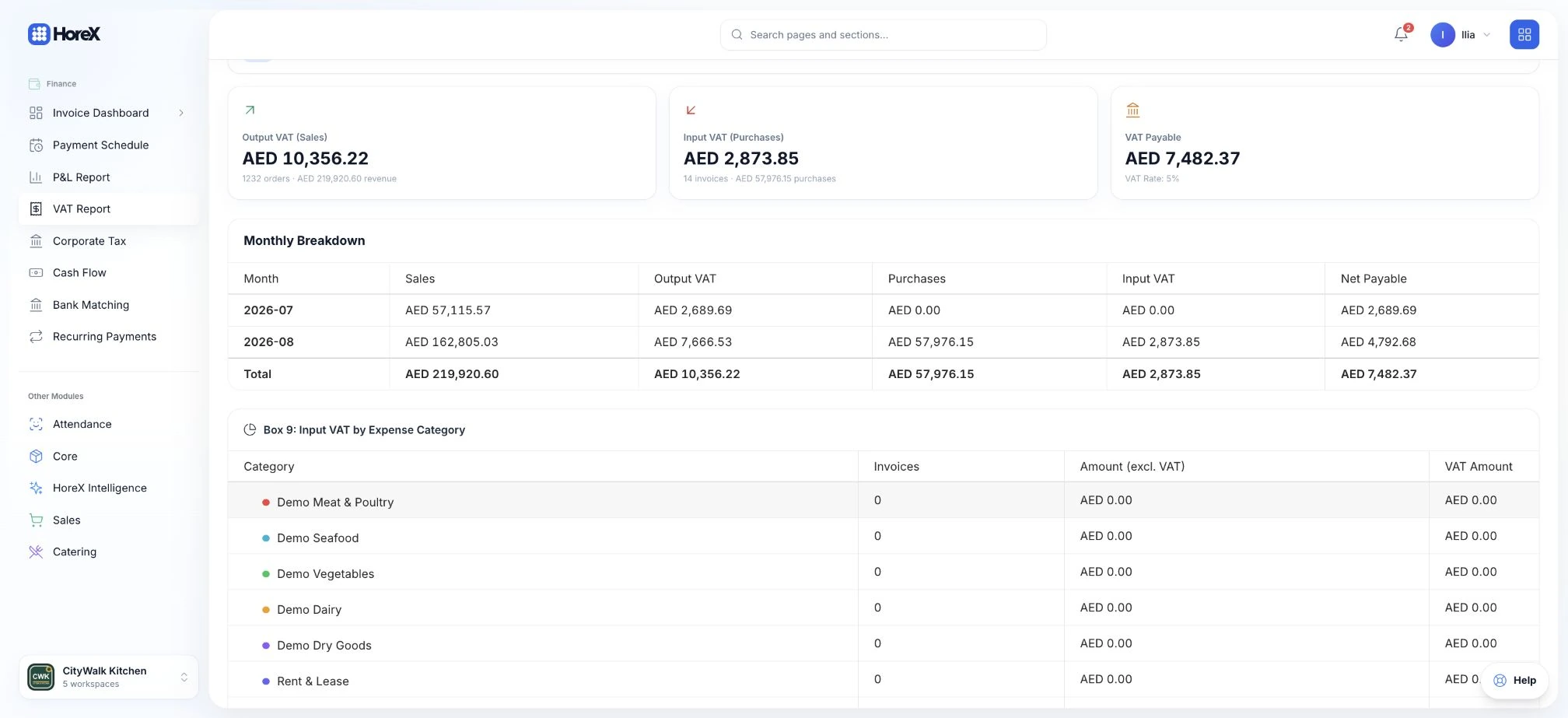
UAE restaurants charge 5% VAT on every food and beverage sale — dine-in, takeaway, and delivery — and must file a VAT return with the Federal Tax Authority (FTA) within 28 days of each quarter-end. Mandatory VAT registration kicks in when annual taxable supplies exceed AED 375,000. Late payment carries penalties starting at 2% immediately and rising to 4% per month, with no cap short of 300%. This guide covers every rule UAE restaurant owners and finance managers need to know, with verified sources.
UAE VAT has been in force since January 2018 — yet many restaurant operators still run into compliance gaps: input VAT not fully recovered, service charges mis-categorized, or a quarterly return filed a day late. The FTA conducted 93,000 inspection visits in 2024, a 135% increase from the previous year, and hospitality businesses face a higher-than-average audit rate because of transaction volume and VAT complexity. The rules are not difficult, but they require consistent execution across every shift, every supplier invoice, and every quarter-end.
In this guide
- VAT registration: when UAE restaurants must register
- VAT rates for restaurants: what is standard-rated
- Input VAT: what restaurants can recover
- Filing VAT returns: Form 201, deadlines, and frequency
- Penalties for late filing and late payment
- Service charges, tips, and discounts
- E-invoicing mandate: what changes in 2026–2027
VAT registration: when UAE restaurants must register
UAE VAT registration is governed by Federal Decree-Law No. 8 of 2017. There are two thresholds, both measured against the 12-month trailing value of taxable supplies and imports:
| Threshold | Amount (AED) | Action required |
|---|---|---|
| Mandatory registration | 375,000 | Must register; apply within 30 days of exceeding |
| Voluntary registration | 187,500 | May register; allows input VAT recovery from day one |
For a restaurant doing AED 60,000 per month in food sales, the mandatory threshold is crossed at roughly month seven. At that point, the business has 30 days to submit a registration application through the FTA's EmaraTax portal. Registering late carries a fixed penalty of AED 20,000.
Voluntary registration is worth considering from the moment a new restaurant starts purchasing kitchen equipment, fit-out materials, and supplies — all of which carry 5% VAT you can recover as input VAT if registered. A restaurant spending AED 500,000 on a fit-out recovers AED 25,000 in input VAT that an unregistered business simply loses.
Note on multi-branch operations
Restaurant groups operating multiple outlets under a single Trade License typically register under one TRN. The combined revenue of all branches counts toward the registration threshold. Each branch's sales and purchases are consolidated into the same VAT return. If branches operate under separate legal entities, each entity registers separately once it crosses the threshold.
VAT rates for restaurants: what is standard-rated
Almost every sale a UAE restaurant makes is subject to VAT at the standard rate of 5%. This covers:
- Dine-in meals — the full bill, including food, beverages, and any applicable service charge
- Takeaway orders — food and drinks sold for off-premises consumption
- Delivery orders — whether using your own drivers or through a third-party aggregator
- Catering contracts — events, corporate meals, and hospitality services
- Non-alcoholic beverages — water, juices, soft drinks, coffee, and tea sold at the restaurant
The key distinction that trips up new operators: raw food ingredients sold by a supermarket are zero-rated under UAE VAT. But the moment a restaurant buys those same ingredients, processes them into a dish, and sells it to a customer, the supply becomes a mixed package of goods and service — classified as standard-rated at 5%. There is no partial zero-rating for the food component of a restaurant meal.
What is zero-rated or exempt for restaurants
In practice, almost nothing that a restaurant sells to customers is zero-rated or exempt. The main edge cases:
- Exported catering services — if the catering supply is physically delivered and consumed outside the UAE, it may qualify as an exported service (zero-rated). Verify with a UAE tax advisor before claiming.
- Healthcare or educational institution food services — specifically contracted services to government-recognized healthcare or educational facilities may have different treatment. Rare for typical commercial restaurants.
When in doubt, apply 5%. The risk of under-declaring VAT far outweighs the risk of over-declaring, since over-declarations create an input VAT credit rather than a penalty.
Input VAT: what restaurants can recover
Input VAT is the 5% you pay on business purchases. For a restaurant doing AED 1.5 million per month in revenue, food purchases alone might represent AED 450,000 — meaning AED 22,500 per month in input VAT available for recovery. Across the full cost base (equipment, rent, utilities, marketing), the recoverable amount is larger.
UAE restaurants can recover input VAT on:
- Raw food ingredients — all supplier purchases carrying 5% VAT (zero-rated ingredients, like some produce, carry no input VAT to recover)
- Kitchen equipment — ovens, fridges, dishwashers, KDS screens, POS hardware
- Fit-out and leasehold improvements — construction, FF&E, signage
- Rent — if the landlord is VAT-registered and charges VAT on commercial rent
- Utilities — DEWA electricity and water bills carry VAT
- Marketing and advertising — agency fees, digital ads, printing
- Software and technology — POS systems, restaurant management platforms, AI invoice scanning tools
- Staff uniforms — if purchased for business use
Requirements to claim input VAT
To recover input VAT from a supplier, three conditions must be met:
- The supplier must be VAT-registered and have a valid TRN (Tax Registration Number). You can verify supplier TRNs on the FTA's public TRN verification tool at tax.gov.ae.
- You must hold a valid tax invoice from the supplier — showing their TRN, your TRN, the VAT amount, the date, and the supply details.
- The purchase must be for business use. Input VAT on expenses that are for non-business or personal purposes is not recoverable.
Common input VAT mistake
Many restaurants lose input VAT by filing claims against invoices from unregistered suppliers. If your produce or meat supplier does not have a valid UAE TRN, no input VAT can be claimed — even if the invoice shows a VAT amount. Always verify TRNs before building supplier relationships, not after the invoices have accumulated.
Filing VAT returns: Form 201, deadlines, and frequency
UAE VAT returns are filed through the FTA's EmaraTax portal using VAT Form 201. The form asks for totals across specific categories — it does not require uploading every invoice, but the FTA can request an audit file (FAF) that contains all transaction-level detail at any point.
Filing frequency
The FTA assigns your filing frequency based on turnover:
| Annual taxable supplies | Filing frequency | Deadline |
|---|---|---|
| Below AED 150 million | Quarterly | 28 days after quarter end |
| AED 150 million and above | Monthly | 28 days after month end |
Nearly all UAE restaurants file quarterly. The 2026 quarterly deadlines are:
- Q1 2026 (Jan–Mar): 28 April 2026
- Q2 2026 (Apr–Jun): 28 July 2026
- Q3 2026 (Jul–Sep): 28 October 2026
- Q4 2026 (Oct–Dec): 28 January 2027
FTA Form 201 — the key boxes
Form 201 maps your VAT data into specific boxes. Understanding what goes where matters for accurate filing:
| Box | What it covers | For restaurants |
|---|---|---|
| Box 1a | Standard rated supplies (5%) | Total food & beverage sales |
| Box 3 | Zero-rated supplies | Exported catering (if applicable) |
| Box 6 | Standard rated expenses | Supplier purchases with 5% VAT |
| Box 7 | Exempt expenses | Typically zero for restaurants |
| Box 9 | Net VAT payable | Box 1a VAT − Box 6 VAT = net due |
A worked example: quarterly VAT return for a Dubai restaurant
| Total food & beverage sales (ex-VAT) | AED 800,000 |
| Output VAT collected (5% × 800,000) | AED 40,000 |
| Supplier ingredient purchases (ex-VAT) | AED 280,000 |
| Input VAT on ingredients (5% × 280,000) | AED 14,000 |
| Other business expenses with VAT (rent, utilities, equipment) | AED 80,000 |
| Input VAT on other expenses (5% × 80,000) | AED 4,000 |
| Total input VAT claimable | AED 18,000 |
| Net VAT payable to FTA (Box 9) | AED 22,000 |
The FTA Audit File (FAF)
The FAF is the transaction-level backup for your VAT return. The FTA can request it at any time for any period, including years after the return was filed. It must contain: all POS sales with VAT breakdown, all supplier invoices with TRN and VAT amounts, credit notes, and adjustment entries — formatted to FTA specification. Producing the FAF from paper records and spreadsheets is a multi-day exercise; from a properly configured restaurant management system it is a one-click export.
Penalties for late filing and late payment
The UAE Cabinet revised the VAT penalty structure under Federal Decree-Law No. 16 of 2025, with changes effective from 14 April 2026. The revised framework applies a more graduated approach but the core numbers are unchanged:
| Violation | Penalty |
|---|---|
| Late VAT return filing (first offense) | AED 1,000 |
| Late VAT return filing (repeated within 24 months) | AED 2,000 |
| Late payment: immediate penalty | 2% of unpaid VAT |
| Late payment: monthly accrual | 4% per month on outstanding balance |
| Maximum late payment penalty | 300% of original tax due |
| Failure to register for VAT | AED 20,000 |
What a 14-day late payment costs in practice
| Late return filing penalty | AED 1,000 |
| Immediate late payment penalty (2% × 22,000) | AED 440 |
| Daily accrual for 14 days (4%/month ≈ 0.13%/day × 14) | AED 399 |
| Total penalties for 14 days late | AED 1,839 |
Voluntary disclosure
If you discover an error in a previously filed VAT return — under-declared output VAT or over-claimed input VAT — you can correct it voluntarily using FTA Form 211 (Voluntary Disclosure). Filing within 20 business days of discovering the error attracts a lower graduated penalty (5%–50% of the underpaid VAT, depending on timing). Waiting until the FTA discovers the error in an audit results in a significantly higher penalty. The 2026 framework explicitly incentivizes proactive self-correction over waiting to be caught.
Service charges, tips, discounts, and delivery commissions
Several line items on a restaurant income statement have specific VAT treatment that differs from the main food revenue:
Service charges
A mandatory service charge — the "10% service charge" that many UAE restaurants add automatically to bills — is part of the taxable consideration. It is subject to 5% VAT. This is because the service charge is compulsory: customers have no choice about paying it, so it forms part of the total price charged for the restaurant supply.
In practice, if your bill shows AED 200 food + AED 20 service charge = AED 220 subtotal, the 5% VAT applies to the full AED 220 → AED 11 VAT → AED 231 total.
Voluntary tips
Tips voluntarily left by customers — cash on the table, tip added to a card terminal at the customer's discretion — are outside the scope of VAT. They are treated as a gift from the customer and do not form part of the taxable consideration. Make sure your POS system and Z-reports categorize tips separately from revenue.
Discounts and promotions
If you apply a discount before the sale is completed, VAT is calculated on the discounted price. A 20% "happy hour" discount on a AED 50 cocktail: VAT is on AED 40, not AED 50. If a credit note is issued after the fact (a refund or retroactive discount), it reduces your output VAT accordingly.
Delivery platform commissions
The commission you pay to Talabat, Deliveroo, or Noon Food is a taxable service fee — the platform charges you VAT on their commission. This is input VAT you can recover, provided the platform issues a valid tax invoice with their TRN. Keep every platform invoice and reconcile monthly against your platform payout statements.
Tourist VAT refund scheme
Restaurant meals are explicitly excluded from the UAE tourist VAT refund scheme. The scheme applies only to physical goods purchased from registered retailers and exported from the UAE. A tourist who spends AED 3,000 at your restaurant cannot claim a VAT refund — regardless of the total spend or whether they are departing from the country. Only unopened, unconsumed food products (from a retail context) might qualify. This is confirmed on the FTA's dedicated tourist refund page.
E-invoicing mandate: what changes in 2026–2027
The UAE is implementing a mandatory e-invoicing system under a Peppol-based Continuous Transaction Control (CTC) framework. The Ministry of Finance published the compliance guide in February 2026. Here is the phased timeline:
| Phase | Date | Who is in scope |
|---|---|---|
| Pilot programme | July 2026 | Voluntary participation for all businesses |
| Phase 1 — Mandatory | January 2027 | Businesses with annual revenue ≥ AED 50 million |
| Phase 2 — Mandatory | July 2027 | All remaining businesses (revenue < AED 50 million) |
| Phase 3 — B2G | October 2027 | Business-to-government transactions |
What e-invoicing means for restaurants
B2C transactions are currently excluded. A restaurant issuing a POS receipt to an individual diner does not fall under the mandate — consumer-facing receipts remain outside the scope. This means the vast majority of what a restaurant does day-to-day is unaffected in the short term.
B2B invoices are in scope. If your restaurant issues invoices to corporate clients — for catering events, regular corporate lunch programs, or hospitality services — those invoices will need to be issued as structured XML documents and transmitted through an FTA-Accredited Service Provider (ASP). For most restaurants, the relevant date is July 2027 (Phase 2, revenue below AED 50 million).
What needs to change technically. E-invoices must be generated in XML format (UBL or PINT-AE standard), include all mandatory fields specified by the FTA, and be transmitted via an ASP before being sent to the client. Your restaurant management or accounting system must be capable of generating compliant XML output. The Ministry of Finance's February 2026 guide specifies the mandatory data fields.
What to do now
Even if your mandatory compliance date is July 2027, the pilot phase from July 2026 is worth participating in. It gives your team time to test the workflow — XML generation, ASP connectivity, and data field completeness — without compliance pressure. Businesses that wait until July 2027 to start will be competing for ASP capacity with every other sub-AED 50M operator simultaneously.
Frequently asked questions
Do UAE restaurants charge VAT on all food sales?
Yes. All restaurant sales — dine-in, takeaway, and delivery — are subject to 5% VAT. Even though raw food ingredients are zero-rated when purchased at a supermarket, once a restaurant processes those ingredients into a meal and serves it to a customer, the full supply becomes standard-rated at 5%. There is no partial zero-rating for the food component of a restaurant dish. Source: FTA UAE.
Can UAE restaurants recover input VAT on ingredient purchases?
Yes. Restaurants can recover input VAT on raw ingredients, kitchen equipment, rent (if VAT-charged by the landlord), utilities, and marketing expenses. To claim input VAT, the supplier must be VAT-registered, issue a valid tax invoice showing their TRN, and the purchase must be for business use. You cannot claim input VAT from suppliers who are not registered for VAT. Source: FTA VAT Guide.
When is the VAT filing deadline for UAE restaurants?
Most UAE restaurants file quarterly — within 28 days from the end of each quarter. The 2026 quarterly deadlines are: 28 April (Q1), 28 July (Q2), 28 October (Q3), and 28 January 2027 (Q4). Businesses with annual taxable supplies above AED 150 million file monthly. The FTA assigns your filing frequency; you cannot change it without FTA approval. Source: UAE FTA, ASC Global VAT Calendar 2026.
What are the penalties for late VAT filing and payment?
Late VAT return filing: AED 1,000 for the first offense; AED 2,000 for a repeated late filing within 24 months. Late payment: 2% of the unpaid VAT amount immediately after the due date, then 4% per month on the outstanding balance, capped at 300%. These updated penalty rules are effective from 14 April 2026 under Federal Decree-Law No. 16 of 2025. Source: UAE Cabinet Decision, FTA.
Are restaurant meals included in the UAE tourist VAT refund scheme?
No. Restaurant meals are explicitly excluded. The UAE tourist VAT refund scheme applies only to physical goods purchased from registered retailers and exported from the UAE. Services — including restaurant meals, hotel stays, and transportation — do not qualify. A tourist spending AED 5,000 at your restaurant cannot claim any VAT refund, regardless of the amount spent. Source: FTA UAE (tax.gov.ae), UAE Official Platform.
Does the UAE e-invoicing mandate affect restaurants?
Partially. Consumer-facing POS receipts (individual diners) are currently excluded from the mandate. However, B2B invoices issued to corporate clients for catering, events, or regular orders will be in scope. For restaurants with annual revenue below AED 50 million, the mandatory compliance date is July 2027. The pilot phase begins July 2026. Source: UAE Ministry of Finance, February 2026; VATupdate.
Sources
- Federal Tax Authority UAE — Registration for VAT (registration thresholds: AED 375,000 mandatory, AED 187,500 voluntary)
- Federal Tax Authority UAE — VAT Refund for Tourists (restaurant meals excluded)
- UAE Official Platform — VAT Refund for Tourists
- ASC Global — VAT Return Filing Compliance Calendar 2026 (deadlines and penalty structure)
- Mazeed — VAT Late Payment Penalty UAE 2026 (2% immediate, 4%/month, 300% cap)
- EASMEA — VAT for F&B: A Restaurant Owner's Compliance Guide (dine-in, takeaway, delivery rates; service charges vs. tips)
- VATupdate — UAE Peppol E-Invoicing Mandate: Phased Rollout July 2026–October 2027
- Alvarez & Marsal — FTA Risk-Based Audits 2026 (93,000 inspections in 2024; hospitality audit risk)