How to Calculate Food Cost Percentage — UAE Restaurant Guide
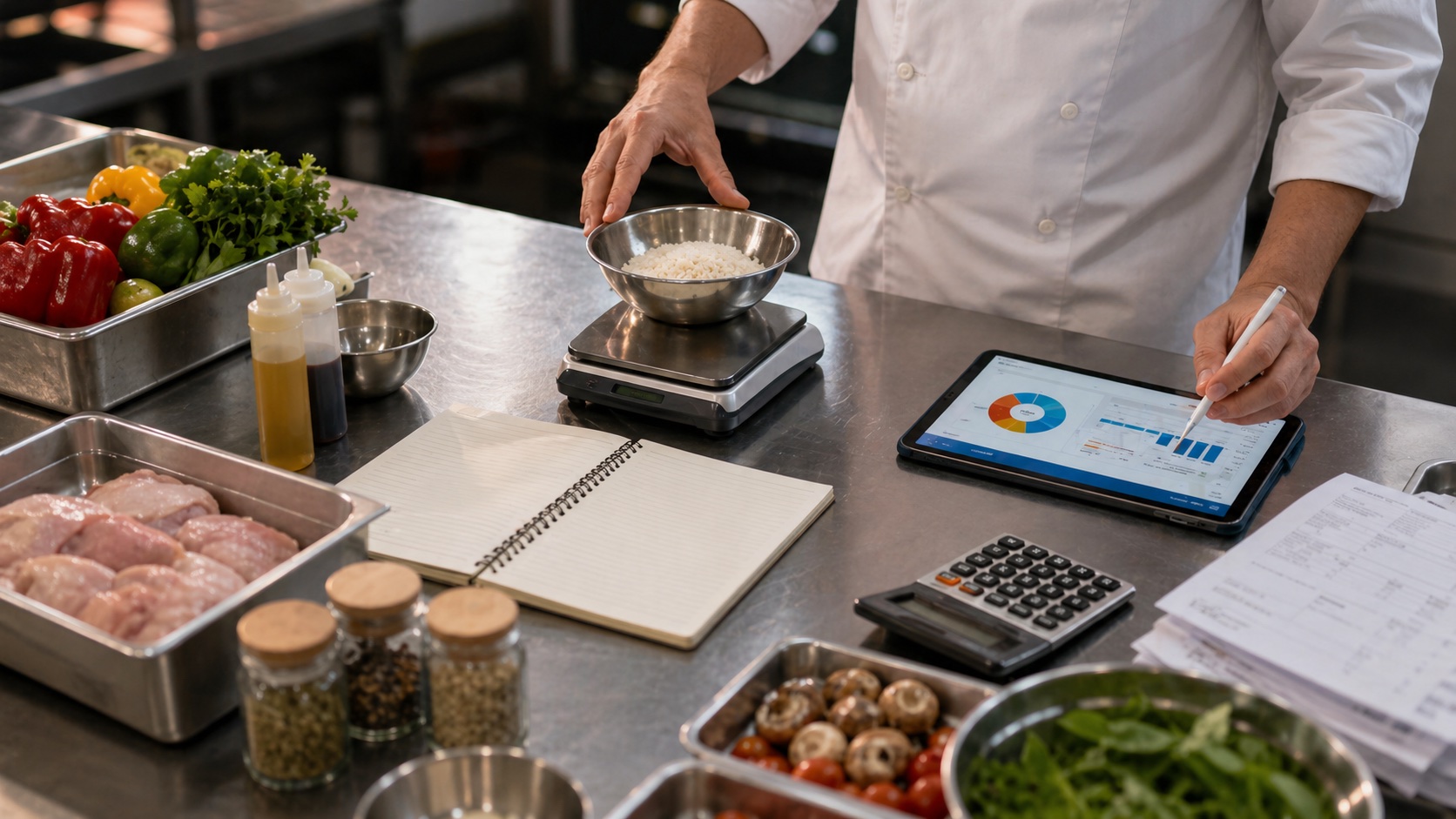
It's the end of the month. You pull the P&L and your food cost came in at 37% — not the 28% you budgeted. That's AED 45,000 gone. You probably know where about half of it went. The other half is why this guide exists.
Food cost percentage is just food cost divided by food revenue. The math is easy. What's hard is actually running your kitchen in a way that keeps the number where it should be — 25-35% in UAE, depending on your segment. This guide walks you through the three calculations every operator needs, AED-level worked examples, UAE benchmarks, and — most importantly — where the money usually disappears.
In this guide
The Math: Three Formulas, One Kitchen
Most guides throw a single formula at you and call it a day. You actually need three — each answers a different question.
1. Food cost percentage for the period
This is the number your accountant cares about. It tells you what you actually spent on food last week, last month, or last quarter — as a share of food revenue.
Count your inventory at the start of the week. Add everything you bought from suppliers. Count again at the end. Divide by how much food you sold. Here's what that looks like in dirhams for a typical Dubai casual dining restaurant:
| Beginning inventory (Sunday morning) | AED 22,000 |
| Purchases (all supplier invoices Mon-Sat) | + AED 38,500 |
| Ending inventory (Saturday close) | − AED 21,200 |
| Total food cost (COGS) | AED 39,300 |
| Food revenue for the week | AED 126,000 |
Run this weekly. Monthly is too slow — by the time you spot a problem, you've been bleeding for three or four weeks.
2. Plate cost (aka recipe cost)
This is the cost of making one serving of a specific dish. It's the number your chef should know by heart for every item on the menu:
We'll cost out a chicken shawarma plate below, ingredient by ingredient, in actual Dubai prices. If you want to skip the math, our free food cost calculator does it for you.
3. Menu price from a target food cost
The reverse direction. Start with plate cost and a target food cost %, get the minimum price you can charge:
A chicken shawarma plate that costs AED 8.55 to make, at a 30% target food cost, needs to sell for at least AED 28.50. Round up to AED 29 or AED 30 for a cleaner menu. If your competitors across the street charge AED 25, you've got two choices: cut the plate cost or accept a thinner margin to stay competitive.
Why UAE Is a Different Game
The global rule of thumb is 28-32% food cost. In the UAE, owners often push for 25-28% — not because they're stingier, but because rent and labor eat more of the pie.
Three UAE-specific pressures worth naming:
- 80-90% of food is imported (World Economic Forum). That adds logistics, cold-chain, and FX costs you don't have in markets with domestic agriculture.
- Prime-location rent is aggressive. In Downtown Dubai, DIFC, or JBR, you'll see restaurants paying 18-22% of revenue on rent alone, per GGB Consulting's UAE data.
- Delivery commissions can hit 35% per order on Talabat, Deliveroo, and Noon. If 40% of your revenue is delivery and commission is 30%, you've lost 12% of revenue before food, staff, or rent.
30% food, 30% labor, 20% miscellaneous, 20% profit. Joe Bastianich's old rule — still a target, even if the 20% net margin is hard to hit on a Downtown Dubai lease.
Most well-run UAE operators land between 8% and 15% net margin.
What Good Looks Like — UAE Benchmarks by Segment
Benchmarks to aim for in UAE. These are tighter than US averages because rent pressure forces food cost down:
| Segment | Target Food Cost | What drives it |
|---|---|---|
| QSR / Fast Food | 25-30% | Tight recipes, bulk buying |
| Fast Casual | 27-32% | Higher quality ingredients, heavy delivery mix |
| Casual Dining | 28-35% | Menu complexity, staff meals, dine-in waste |
| Fine Dining | 32-38% | Premium imports, seasonality, higher trim waste |
| Cloud Kitchen | 28-33% | No FOH, but commission squeeze |
| Catering | 30-35% | Efficient cooking, transport waste |
The US National Restaurant Association's 2024 survey of 900+ operators put the median at 32% full-service and 32.4% limited-service. If you're hitting those numbers in Dubai with 20% rent, you're probably losing money. Aim lower.
Costing a Chicken Shawarma Plate — the Right Way
The only way to know your real food cost is to cost every dish line by line. Here's a chicken shawarma plate with approximate Dubai mid-range supplier prices — the kind of detail most operators skip, and then wonder why their numbers are off.
| Chicken thigh (marinated), 200g | AED 3.80 |
| Arabic bread (2 pcs) | AED 0.60 |
| Garlic sauce (toum), 40g | AED 0.45 |
| Pickled turnips & cucumbers, 50g | AED 0.35 |
| Mixed salad (lettuce, tomato, onion), 80g | AED 0.65 |
| French fries, 120g | AED 0.90 |
| Hummus, 60g | AED 0.55 |
| Spice marinade & cooking oil | AED 0.45 |
| Packaging (dine-in plate/service) | AED 0.40 |
| Waste allowance (5%) | AED 0.40 |
| Total Plate Cost | AED 8.55 |
Same plate at three different target food costs, for comparison:
| Target Food Cost | Calculation | Menu Price |
|---|---|---|
| 25% (aggressive) | 8.55 ÷ 0.25 | AED 34.20 |
| 30% (standard) | 8.55 ÷ 0.30 | AED 28.50 |
| 35% (value-priced) | 8.55 ÷ 0.35 | AED 24.43 |
Most casual spots in Dubai sell this plate at AED 28-35. At AED 30 with a plate cost of AED 8.55, you're running 28.5% food cost on that item — solid. Do this for every dish and you've got a menu you can actually defend on paper.
Doing this once in Excel is doable. Doing it across 60 menu items, updating it every time a supplier changes prices, and rolling it up into weekly reports — that's where HoreX's recipe module earns its keep. Ingredient costs pull from purchase orders automatically, so your plate costs stay current without anyone editing a spreadsheet.
The Variance Problem — Where Money Actually Disappears
Here's the part most operators underestimate. You can have perfect recipe cards and still run way over target. Why? Because theoretical food cost (what your recipes say you should spend) and actual food cost (what you really spent) almost never match.
That gap is your variance. It's where the money goes.
| Format | Acceptable variance | You've got a problem at |
|---|---|---|
| QSR | 1.5-3% | > 3% |
| Full-service | 3-5% | > 5% |
Here's what that looks like in money. Say your recipes say food cost should be 28%, but your COGS shows 34%. That's 6% variance. On a restaurant doing AED 500,000 monthly revenue:
6% of AED 500,000 = AED 30,000/month. AED 360,000 a year. Gone.
Nobody's stealing 360 grand worth of shawarma. The money leaks out of six places, and it's almost always the same six:
- Over-portioning. No portion scales in the kitchen. Staff eyeball the chicken, and "200g" becomes 240g. That alone is a 20% overage on your biggest ingredient.
- Supplier price creep. You agreed AED 22/kg for chicken thigh in January. By April it's AED 24.50 and nobody noticed because nobody checks invoices against the quote.
- Spoilage. Hits harder here because imported produce already spent a week in cold chain before it reached you.
- Theft. Uncomfortable to name but real. Usually small, usually steady, usually unnoticed.
- Recipe drift. Line cook thinks extra hummus makes the plate better. Over a year, it makes your margin worse.
- Unrecorded staff meals. Ten employees eating one AED 15 meal each shift, six days a week = AED 3,600 a month that never made it onto a P&L.
Finding the leak means counting inventory more often, costing recipes accurately, and comparing the two. HoreX's inventory module runs this comparison continuously and alerts you when variance crosses your threshold — catching leaks in week one, not month three.
The Menu Matrix — A 4-Quadrant Trick Every Menu Needs
Food cost is one side of profit. The other is menu mix. Every dish on your menu is one of four things, based on two questions: does it sell, and does it make money?
This is the Kasavana-Smith matrix, and it's the cleanest menu tool ever built. Run it quarterly. You need two data points per dish: how many sold in the period, and contribution margin (menu price minus plate cost). Plot every item. Then act.
Roger Fields in Restaurant Success by the Numbers puts it well: the goal isn't all Stars. The goal is zero Dogs, and understanding why each Plowhorse is popular despite the thin margin.
Six Things That Actually Move the Number
Skip the generic advice. These are the moves that consistently pull food cost down in UAE kitchens — in order of how fast you'll see impact.
Put portion scales on every station
If a prep cook can "feel" 200 grams, they can also "feel" 240. That one change typically pulls 2-3 points off your food cost within a month. Non-negotiable.
Re-quote your top 5 suppliers every quarter
Annual contracts are how you end up overpaying by 8% six months in. Bidfood, Brakes, Barakat, Kibsons, and the wholesalers at Dubai's Waterfront Market all bid aggressively when they know they're being compared. Quarterly is the sweet spot.
Check every invoice against the PO the day it arrives
A case of salmon invoiced at AED 185/kg instead of the agreed AED 170 adds up fast. Most discrepancies are honest — supplier updated prices, your team didn't catch it. But you pay either way. HoreX AI Invoice Scanning does this automatically: photograph the invoice, it matches to the PO, and flags anything off.
Log waste by station, every shift
Not "we had some waste today." Actual numbers: 800g of trim on the grill station, 1.2kg of wilted herbs on cold prep, one broken case of eggs on receiving. When staff know waste is measured, it drops — fast.
Engineer the menu quarterly, not "sometime"
Put the matrix on your calendar. 90 days is enough to see which items moved. A single well-executed menu engineering pass usually lifts contribution margin 10-15% — without changing a single ingredient.
Build a direct order channel before delivery commissions kill you
If 40% of your revenue is Talabat at a 30% commission, you're giving away 12% of top-line before food costs. A WhatsApp order flow or a simple direct-order page, plus a loyalty incentive, can shift 15-20% of those orders back to your margin. That's often the difference between profit and break-even.
Frequently asked questions
What is a good food cost percentage for a restaurant in UAE?
A good food cost percentage for UAE restaurants ranges from 25% to 35%, depending on the segment. QSR and fast casual typically target 25-32%, casual dining 28-35%, and fine dining 32-38%. The NRA's 2024 survey of 900+ operators found a median of 32.0% for full-service restaurants. UAE operators often run slightly lower food costs (around 25% per GGB Consulting) because higher rent and labor costs consume a larger share of revenue.
How do you calculate food cost percentage?
Food Cost % = (Beginning Inventory + Purchases − Ending Inventory) ÷ Food Revenue × 100. For example, if your beginning inventory is AED 22,000, purchases are AED 38,500, ending inventory is AED 21,200, and food revenue is AED 126,000 — your food cost is (22,000 + 38,500 − 21,200) ÷ 126,000 × 100 = 31.2%.
Why is food cost higher in UAE than other markets?
The UAE imports 80-90% of food consumed, according to the World Economic Forum. This import dependency adds logistics, cold-chain, and currency exchange costs. However, UAE food inflation has been relatively stable at 1.02% year-over-year (December 2025, Trading Economics), so cost spikes are more about operational inefficiency than market forces.
What is the difference between theoretical and actual food cost?
Theoretical food cost is what costs should be if every dish is made perfectly to spec with zero waste. Actual food cost is what you really spent. The variance reveals waste, theft, over-portioning, and recipe non-compliance. Acceptable variance is 1.5-3% for QSR and 3-5% for full-service restaurants (CrunchTime).
How do I price a menu item based on food cost?
Use the reverse formula: Menu Price = Plate Cost ÷ Target Food Cost %. If a dish costs AED 8.55 in ingredients and you target 30% food cost, the minimum price is 8.55 ÷ 0.30 = AED 28.50. Round to the nearest psychological price point and verify against competitor pricing.
How often should I calculate food cost percentage?
Weekly at minimum, ideally daily. Monthly calculations catch problems too late — a single week of over-portioning or waste can cost thousands of dirhams before you notice. Real-time tracking through integrated systems gives you per-dish cost visibility after every service.
Sources
- National Restaurant Association — Restaurant Operators Kept Food Cost Ratios in Check in 2024 (900+ operators surveyed, median food cost 32%)
- GGB Consulting — Restaurant Profit Margins in UAE: Industry Benchmarks
- Restroworks — Dubai Restaurants Statistics (13,000+ restaurants, $23.21B market)
- World Economic Forum — Gulf Food Security & Innovation (UAE imports 80-90% of food)
- Trading Economics — UAE Food Inflation (1.02% YoY, Dec 2025)
- Aaron Allen & Associates — How to Reduce Restaurant Food Cost (25-35% benchmark range)
- CrunchTime — Explaining Actual vs Theoretical Food Cost Variance
- Toast — How to Calculate Food Cost Percentage (COGS formula guide)
- Lightspeed — How to Calculate Restaurant Food Costs (recipe costing method)
- Alpen Capital — GCC Food Industry Report 2025
- Kasavana, M. & Smith, D. (1982). Menu Engineering: A Practical Guide — Michigan State University (Stars-Dogs matrix)
- Fields, R. Restaurant Success by the Numbers — Ten Speed Press