What Is HoreX? Operator-First Restaurant Platform for UAE
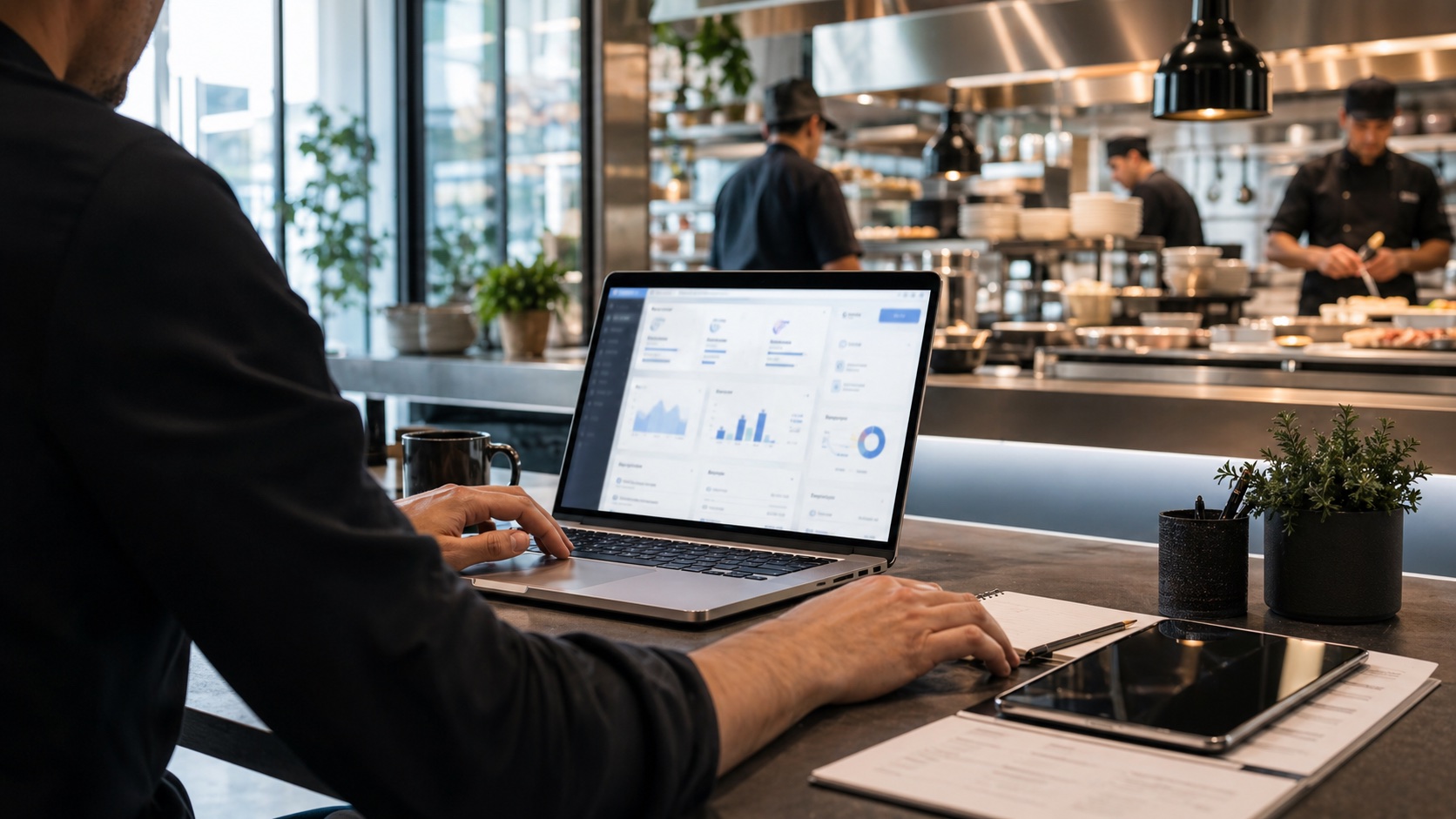
HoreX is a restaurant management platform for UAE HoReCa businesses — POS, inventory, recipe costing, AI invoice scanning, procurement, VAT reporting, HR, CRM, marketing, and analytics in one system, one database, one vendor. We built it to close the gap between what UAE operators actually need and what globally-built software delivers. This page explains what HoreX is, how we work, and what it is not.
Most software pitches start with the problem. We'll start with the context: the UAE restaurant market runs on one of the most demanding compliance environments in the world, serves one of the most diverse dining populations anywhere, and has been historically served by software built for US or European restaurants with regulatory bolt-ons added later. That gap — between what the floor needs and what the system delivers — is where we operate.
In this guide
What HoreX is, in one paragraph
HoreX is a restaurant ERP — a single platform that handles every operational system a UAE food and beverage business needs to run: a POS terminal with kitchen display and waiter app, inventory management with recipe-based write-offs, recipe and menu costing, AI-powered supplier invoice scanning, procurement and purchase orders, automated VAT reporting mapped to FTA Form 201, finance and P&L, HR and staff management, CRM, loyalty, delivery management, marketing, and analytics. One database. One login. One vendor. AED primary currency. Built to be FTA-compliant and DMChecked-aware from day one, not retrofitted to be.
The "one database" part is not a marketing line. It is an architectural decision with practical consequences. When a POS sale is made, ingredients deduct from stock based on recipe cards — without any data export or sync job. When a supplier invoice is posted, stock increases, recipe costs recalculate via Weighted Average Cost, and COGS entries appear in Finance — in one posting action, because all three modules read and write to the same tables. When the VAT period closes, input and output VAT are already reconciled because POS and invoice data were recorded in the same system all quarter.
How we work
We are a small team. There is no layer of account executives between the engineers and the restaurants using the product. We talk to Dubai operators weekly — we visit their kitchens, watch their shifts, observe where paper tickets get lost and where the receiving process breaks down. When a feature does not work the way the floor works, we rewrite it.
Every module we ship has a real product page with a documented feature list. We do not sell roadmap promises as current capabilities. If a feature is not on the product page, it does not exist yet. This constraint disciplines how we talk about the product — and it should discipline how you evaluate it.
Why the category is shifting in 2026
The UAE restaurant operator is facing a confluence of compliance changes in 2026 that a POS-first software stack is structurally ill-equipped to handle.
DMChecked replaced FoodWatch Connect
In November 2025, Dubai Municipality launched DMChecked — a new digital inspection platform — at the Dubai International Food Safety Conference. It replaced FoodWatch Connect. Every DM-licensed food establishment, including restaurants, cafes, catering services, and central kitchens, is required to use DMChecked for inspection recording and compliance tracking. The platform enables real-time digital submission of inspection data from mobile devices. Paper-based hygiene logs, which many operators maintained alongside the old system, are being phased out in favour of digital-first compliance records.
For restaurant operators, this means the compliance record that DM inspectors evaluate is digital — which in turn means the data feeding those records needs to be systematically captured during operations, not reconstructed from memory before an inspection visit.
UAE e-invoicing mandate approaching
The UAE Ministry of Finance published Electronic Invoicing Guidelines v1.0 in February 2026. The mandate follows a Peppol-based framework. A pilot programme runs from July 2026. From January 2027, e-invoicing is mandatory for large businesses (annual revenue ≥ AED 50 million). All UAE businesses fall under the mandate from July 2027.
For restaurant operators, this means supplier invoices — the paper documents your receiving team photographs and files — need to flow through a structured digital system that can produce FTA-compliant XML and audit trails. A restaurant processing 30–50 supplier invoices per week, currently handled by manual entry or paper filing, will need a receiving workflow connected to an FTA-ready accounting system.
FTA VAT enforcement has teeth
The FTA has operated since 2018, but penalty enforcement has become more systematic. Late VAT return filing costs AED 1,000 for the first offence and AED 2,000 for repeated delays within 24 months. Late payment adds 2% immediately, 4% on the 7th day, and 1% daily thereafter up to 300%. For a restaurant owing AED 15,000 in quarterly VAT, a two-week delay costs more than AED 2,100 in avoidable penalties. The operators who have always done this manually with an accountant's help are finding the process increasingly difficult to get right, consistently.
The category is shifting because compliance-native software — built for UAE regulations from the ground up — is no longer a nice-to-have. It is what the regulatory environment demands. A US POS with a VAT plugin is not the same thing.
What is different about HoreX
Three things differentiate how we built this product. Each is tied to a real module, not a positioning claim.
1. Invoice AI: from paper to posted in one workflow
The standard UAE restaurant receiving process looks like this: delivery arrives, someone checks the goods, the paper invoice gets handed over, and later that day (or the next morning) a back-office employee types every line item into the system manually. For a restaurant receiving goods from 20–40 suppliers, this daily manual entry is error-prone and creates a bottleneck: yesterday's costs do not appear in today's P&L.
The Invoice AI module changes this workflow. The receiver photographs the supplier invoice on their phone. Our AI OCR engine — which handles Arabic and English invoices, including mixed-language documents — extracts every line item: product name, quantity, unit, unit price, VAT amount, line total. Smart matching compares extracted names against your product catalog using fuzzy matching and learned patterns; the first time you confirm that "Bnls Chkn Brst" maps to "Chicken Breast Boneless," the system remembers it for every future invoice from that supplier. Review the extracted data on screen, post it — and in one action: stock increases, 90-day Weighted Average Cost recalculates for every affected ingredient (propagating to recipe costs), and COGS entries post to Finance. PO three-way matching flags quantity and price discrepancies before posting, so you are not paying for goods you did not receive at prices you did not agree to.
2. One ledger: food-cost percentage is live, not monthly
In most multi-tool stacks — POS + inventory spreadsheet + accounting software — food cost percentage is a monthly report. Someone exports POS sales data, manually enters stock counts, and calculates the number in a spreadsheet. By the time it is ready, the data is already four to six weeks old.
In HoreX, food cost percentage is live because the three data sources — POS sales, recipe cards, and stock movements — all write to the same database. Every POS sale triggers a recipe-based ingredient write-off. Every posted supplier invoice updates ingredient costs via WAC. The food cost percentage on the dashboard reflects today's sales against today's costs. Managers see it before lunch service starts, not at the end of the month.
The same integration applies to VAT. Output VAT accumulates from POS transactions in real time. Input VAT accumulates from posted invoices. When the quarter closes, the VAT Report is already calculated — output VAT from POS minus input VAT from suppliers equals net payable, mapped to FTA Form 201 boxes. You review it in 15 minutes rather than spending a week reconciling.
3. UAE-native from day one
Several things that are configuration options in globally-built software are defaults in HoreX, because this is what UAE restaurants need:
- FTA VAT at 5% — built into POS transaction recording, supplier invoice processing, and the VAT Report module. Supplier TRN validation is built into the procurement flow. FAF export generates in the FTA-required format.
- Arabic and English OCR — Invoice AI handles both scripts natively. Supplier invoices in UAE come in Arabic, English, and mixed formats. The system does not require you to translate before scanning.
- AED primary currency — not a converted USD display.
- Trade licence and TRN fields built in — supplier profiles capture company name, trade licence, and VAT registration number. These are the documents DM and FTA inspectors request, stored in the same procurement workflow where you create purchase orders.
The market we are building for
The UAE foodservice market generated AED 74.9 billion in revenue in 2024, according to Mordor Intelligence industry data, and is projected to continue growing through 2026. The market is not small, and it is not slowing down.
The structural reality of that market is this: most operators — including those doing strong revenue — run their business on a patchwork of tools. A POS for transactions. An Excel spreadsheet for food cost. A WhatsApp group for supplier orders. A separate accounting tool for VAT, managed by a part-time accountant. Each tool is reasonable on its own; together, they create friction, data gaps, and a management burden that grows with each new location.
The wedge between POS-only software and a full restaurant ERP is the wedge we operate in. Cloud kitchens — which typically run multiple brands from a single kitchen and handle delivery-only operations — are an accelerating format in this market, and they often feel the pain of fragmented tooling most acutely: no dine-in revenue to subsidise inefficient back-office processes, and aggressive delivery platform commission structures that make margin management critical.
Restaurant chains — five to fifty locations — face a consolidation problem. Each branch may run the same POS, but consolidating food cost data and stock movements across all branches into a single view requires manual effort that grows with every new location. HoreX's multi-branch architecture handles this at the database level: inventory counts at each branch, inter-branch stock transfers with receiving confirmation, and supplier invoices at each location flow into a single system without manual export or reconciliation.
What we are not
Being explicit about what HoreX does not do is useful to two audiences: operators sizing up the platform, and investors who want to understand the scope of the thesis.
- Not a social-media tool. HoreX does not post to Instagram, manage influencer campaigns, or generate content. There are specialist tools for that.
- Not a delivery aggregator. HoreX does not compete with Talabat, Deliveroo, or Careem — it connects to them. Aggregator channel integration is in development; direct API integration for your own website or mobile ordering app is live now, with orders flowing straight into the kitchen queue.
None of these are apologies. They are boundaries. Software that claims to do everything usually does nothing well. Our focus is the operational core of a UAE food and beverage business: the flow from supplier to kitchen to guest to finance to compliance.
Where to go from here
If you want to understand a specific part of the platform in more depth, each module has its own page:
- Invoice AI — how Arabic and English invoice scanning works, what happens when you post a scanned invoice, and how three-way matching catches supplier discrepancies before they become financial leakage
- Inventory Management — recipe cards, real-time stock tracking, variance analysis (theoretical vs actual), and how stop lists sync across POS, waiter app, and KDS when an ingredient runs out
- VAT Reporting — how output and input VAT are automatically collected, how data maps to FTA Form 201, and what the FTA Audit File contains
- POS System — touch-optimised terminal, offline mode, waiter app, and kitchen display system
If you have read this and want to understand how HoreX fits your specific operation, the most direct path is to talk to us. We will walk through your setup, your supplier volume, and your compliance situation — and show you exactly what the platform handles for your case.
And if you are a potential investor wanting to understand the technical architecture, market dynamics, or product roadmap in more depth — reach out at hello@horex.ae. We do not have a dedicated investor relations page. That is intentional.
Frequently asked questions
Is HoreX for large restaurant chains only, or also for independent restaurants?
HoreX is built for UAE restaurants of any size — from a single-location independent cafe to a 20-branch chain. The platform scales: a small restaurant uses POS, inventory, and recipe costing; a chain adds multi-branch reporting, inter-branch stock management, and procurement centralisation. You pay for what you use.
Does HoreX support Arabic supplier invoices?
Yes. The Invoice AI module handles Arabic and English supplier invoices natively — including mixed-language invoices where product names appear in Arabic and totals in English. The platform UI is in English. AED is the primary currency throughout.
Does HoreX integrate with Talabat, Deliveroo, or Noon Food?
HoreX connects to your own website or mobile ordering app via direct API — online orders flow into the same kitchen queue as dine-in orders. Aggregator integration with Talabat, Deliveroo, and Careem is in development.
What modules does HoreX include?
HoreX includes: POS (with KDS, Waiter App, and offline mode), Inventory Management (recipe cards, stock tracking, counts), Recipe & Menu Management, AI Invoice Scanning, Procurement & Purchase Orders, VAT Reporting (FTA Form 201), Finance & P&L, HR & Staff Management, CRM, Loyalty Program, Delivery Management, Reports & Analytics, and Marketing tools. All modules share one database — no integrations or data exports between them.
Is HoreX VAT-compliant for UAE FTA requirements?
Yes. The VAT Report module automatically collects output VAT from every POS transaction and input VAT from every posted supplier invoice. At period-end, your data is mapped to FTA Form 201 boxes (1a, 3, 6, 7, 9). The FTA Audit File (FAF) exports in the required format. Supplier TRNs are validated before input VAT is claimed. Monthly and quarterly filing periods are both supported.
How is HoreX different from other UAE restaurant POS systems?
Most UAE restaurant software is a POS with optional add-on modules bolted on over time. HoreX was designed from day one as an integrated restaurant ERP — not a POS with extras. When a supplier invoice is posted, it simultaneously updates stock balances, recalculates recipe costs via WAC, and creates COGS entries in the P&L. That three-way update happens in one posting action because inventory, procurement, and finance share the same database — not because three separate systems were integrated.
Sources
- Dubai Municipality — Food Safety Department: dm.gov.ae/municipality-business/food-safety-department-2/
- Dubai Municipality — DMChecked platform launch announcement (Dubai International Food Safety Conference, November 2025): x.com/DMunicipality
- UAE Ministry of Finance — Electronic Invoicing Guidelines v1.0, February 2026: mof.gov.ae/electronic-invoicing-guidelines
- KPMG — UAE Technical Guidance on Mandatory E-Invoicing Fields, February 2026: kpmg.com
- UAE Foodservice Market — industry data (AED 74.9B revenue, 2024): mordorintelligence.com
- UAE Federal Tax Authority — VAT administrative penalties (late filing, late payment): tax.gov.ae
- HoreX — Invoice AI product page: horex.ae/products/invoice-ai/
- HoreX — VAT Report product page: horex.ae/products/vat-report/